What Size File for Milwaukee Chainsaw? (My Sharpening Guide)
I remember the first time my Milwaukee chainsaw stopped slicing and started burning through wood. I figured I just needed a quick touch-up. I walked into the local hardware store and stared at a giant wall of round files. I had absolutely no idea what size file for Milwaukee chainsaw chains I actually needed. I guessed. I guessed completely wrong.
I bought a file that was too thick. I ended up ruining the cutting edge on a perfectly good chain. Since then, I have spent a lot of time learning how to properly maintain my battery-powered saws. Figuring out exactly what size file you need is the first step to getting your saw cutting like it did right out of the box. I want to share exactly what I learned so you do not repeat my silly mistakes.
Figuring Out What Size File for Milwaukee Chainsaw Models
You cannot just grab a random file from your garage to sharpen a chainsaw. You have to match the file diameter directly to the chain on your tool. Milwaukee makes a few different battery saws today. Each one uses a specific chain.
| Milwaukee Saw Model | Factory Chain Pitch | Proper File Size |
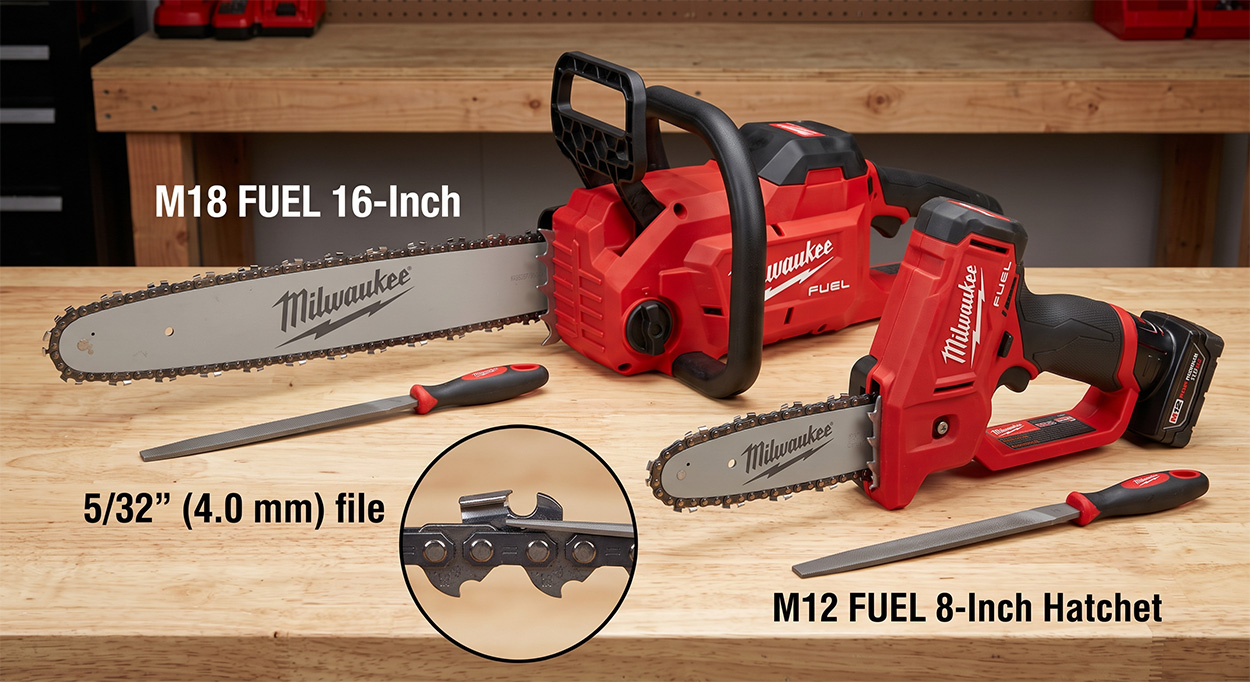
| M18 FUEL 16-Inch | 3/8″ Low Profile | 5/32″ (4.0 mm) |
| M18 FUEL 14-Inch | 3/8″ Low Profile | 5/32″ (4.0 mm) |
| M12 FUEL 8-Inch Hatchet | 3/8″ Low Profile | 5/32″ (4.0 mm) |
Let’s break down the most popular saws in their lineup so you know exactly what to grab at the store.
The M18 FUEL 14-Inch and 16-Inch Chainsaws
These are the main workhorses in the Milwaukee battery lineup. They usually come with an Oregon-brand chain right out of the box. The pitch on these chains is 3/8-inch Low Profile.
For a standard 3/8″ Low Profile chain, you need a 5/32-inch round file. If you prefer metric sizes, that is a 4.0 mm file. This file sits perfectly inside the curve of the cutting tooth.
The Hatchet Pruning Saws
The Hatchet line gets a little tricky. The M18 8-inch Hatchet uses a standard 3/8″ Low Profile chain. So, it takes the exact same 5/32-inch file as the big 16-inch saw. This is great if you own both tools.
However, the smaller M12 6-inch Hatchet is different. Depending on the exact replacement chain you buy, it might use a tiny 1/4-inch pitch chain. Many standard 1/4-inch pitch chains still take a 5/32-inch file. But some micro-chains require a smaller 1/8-inch file. Always read your specific chain box if you have the smaller M12 saw.
Why Chain Pitch Dictates Your File Size
Chainsaw teeth have a very specific curve. You need a round file that fits perfectly inside that curve. If you get this wrong, your saw will not cut.
| Chain Pitch | Recommended File Size |
| 1/4 inch | 1/8″ or 5/32″ |
| 3/8 inch Low Profile | 5/32″ (4.0 mm) |
| .325 inch | 3/16″ (4.8 mm) |
The chain pitch tells you how big the cutting teeth are. Bigger teeth need thicker files. Smaller teeth need thinner files.
If you use a file that is too big, it will blunt the top of the cutting edge. It will not create a sharp point. If you use a file that is too small, you will undercut the tooth. This creates a weak edge that chips easily when it hits hard wood.
Mistakes I Made When Sharpening My Milwaukee
I thought sharpening a chainsaw was just dragging rough metal over dull metal. I was very wrong. I learned the hard way how sensitive a chainsaw chain really is.
| Sharpening Mistake | The Better Approach |
| Pushing down really hard | Use light pressure and let the file cut |
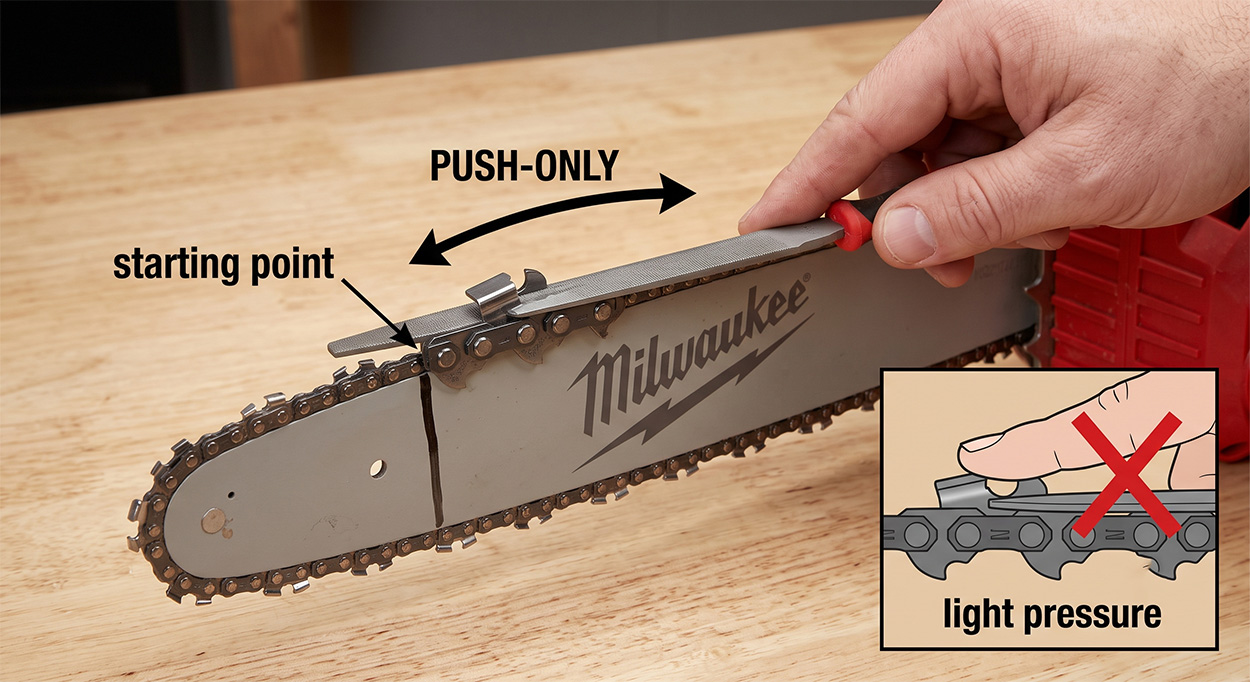
| Dragging the file backward | Only push the file forward, then lift it |
| Guessing the angle | Use a file guide with angle marks |
Pressing Too Hard on the File
I used to push down with all my body weight. I thought more pressure meant a sharper tooth. It just ruined the file.
You only need light, smooth pressure. Let the teeth of the file do the actual cutting. If you have to push hard, your file is probably worn out and needs to be replaced.
My Honest Field Review Milwaukee Mini Chainsaw M18
Forgetting the Depth Gauges
This was my biggest frustration early on. I spent a whole hour filing the teeth until they were razor sharp. I went outside to cut a log. The saw just spun fast and made fine dust. It would not cut.
I completely forgot to file down the depth gauges. The depth gauge is the little bump in front of the cutting tooth. It controls how deep the tooth bites into the wood. If the cutting tooth gets filed back, it gets lower. If the depth gauge stays high, the tooth can never reach the wood.
How to Check Your Chain Specs Before Buying a File
Before you buy a file, you need to read the numbers on your saw. Do not guess like I did. The saw will tell you exactly what it needs.
| Where to Look | What You Will Find |
| Stamped on the metal bar | Pitch, gauge, and drive link count |
| Stamped on the drive links | Manufacturer ID codes |
| The chain box | Exact file size recommendation |
Grab a rag and wipe down the metal bar of your chainsaw. Look near the base, right where the bar attaches to the motor housing. You will see numbers stamped right into the metal.
You are looking for a fraction like 3/8. That is your pitch. Once you know your pitch, you know what size file for Milwaukee chainsaw chains you need. If you replaced your chain with an aftermarket brand recently, just check the box it came in.
Signs It Is Time to File Your Chain
How do you know when to pull out that round file? Your saw will tell you. You just have to listen to the tool and look at what it leaves behind on the ground.
| Dull Chain Symptom | What It Actually Means |
| Fine sawdust instead of chips | The teeth are grinding, not slicing |
| Pushing hard to make a cut | The teeth have lost their sharp edge |
| Smoke coming from the bar | Extreme friction from a dull chain |
When my M18 is sharp, it practically pulls itself into the wood. I barely have to hold it. Big, thick wood chips fly out the back of the saw.
When it gets dull, I have to push down hard. The sawdust looks like fine flour. Stop cutting immediately when you see dust. Pushing a dull chain will burn out your electric motor or ruin your expensive battery very fast.
Why Battery Saws Need Sharper Chains Than Gas Saws
Gas chainsaws are loud and vibrate wildly. It is easy to miss a dull chain on a gas saw. You just rev the engine harder. You cannot do that with a battery saw.
| Saw Type | Reaction to a Dull Chain |
| Gas Powered | Bogs down, smokes, burns extra fuel |
| Battery Powered | Overheats battery, cuts off automatically |
Electric motors have massive torque. But pushing a dull chain drains lithium-ion batteries super fast. I noticed my M18 battery dying in half the time when my chain was dull.
Keeping your chain razor sharp is the best way to get longer run times. A sharp chain saves battery life and keeps the motor cool.
Step-by-Step Sharpening Tips for Beginners
Sharpening looks tricky, but it is just muscle memory. Once you know what size file to buy, the rest is just simple practice.
| Sharpening Tool | Why You Need It |
| Round File | Sharpens the curved cutting tooth |
| File Guide | Keeps the file at the perfect height |
| Flat File | Lowers the depth gauges |
First, take the battery completely out of your Milwaukee saw. Safety first. You never want an accidental trigger pull while your hands are on the chain. Next, tighten the chain a little more than you usually do. A tight chain will not wobble when you run the file across it.
Finding Your Starting Point
One common mistake is sharpening the same teeth twice. You will lose track of where you started.
I keep a black Sharpie in my chainsaw case. I color the top of one tooth black. That becomes my starting point. When I see the black tooth come around again, I know I am finished with that side.
Using a File Guide
I highly recommend buying a file that has a metal guide attached to it. The flat metal guide rests on top of the chain. It keeps the file at the perfect height.
You want about 20 percent of the file sitting above the top plate of the tooth. If you just hold a bare file in your hand, you will eventually dip too low. The guide does the thinking for you.
Getting the Angle Right
Most standard Milwaukee chains need a 30-degree filing angle. Most file guides have little lines stamped right on top of them.
Line that stamped mark up so it is completely parallel to the chainsaw bar. Push the file forward across the tooth. Never drag it backward. Lift it up on the return stroke. Give every single tooth the exact same number of strokes. Three or four passes are usually enough for a quick touch-up.
Final Thoughts
Learning how to sharpen my own chainsaw changed how I work. I no longer waste money buying new chains every time one gets dull. I just pull out my 5/32-inch file, spend ten minutes touching up the teeth, and get right back to cutting.
If you own a standard Milwaukee M18 saw, just buy a quality 5/32-inch round file and a basic guide. Take your time, let the tool do the work, and watch your battery life improve immediately. A sharp saw is a safe saw, and it makes yard work actually fun.