Chainsaw Dies When I Give It Gas: My Quick Fixes
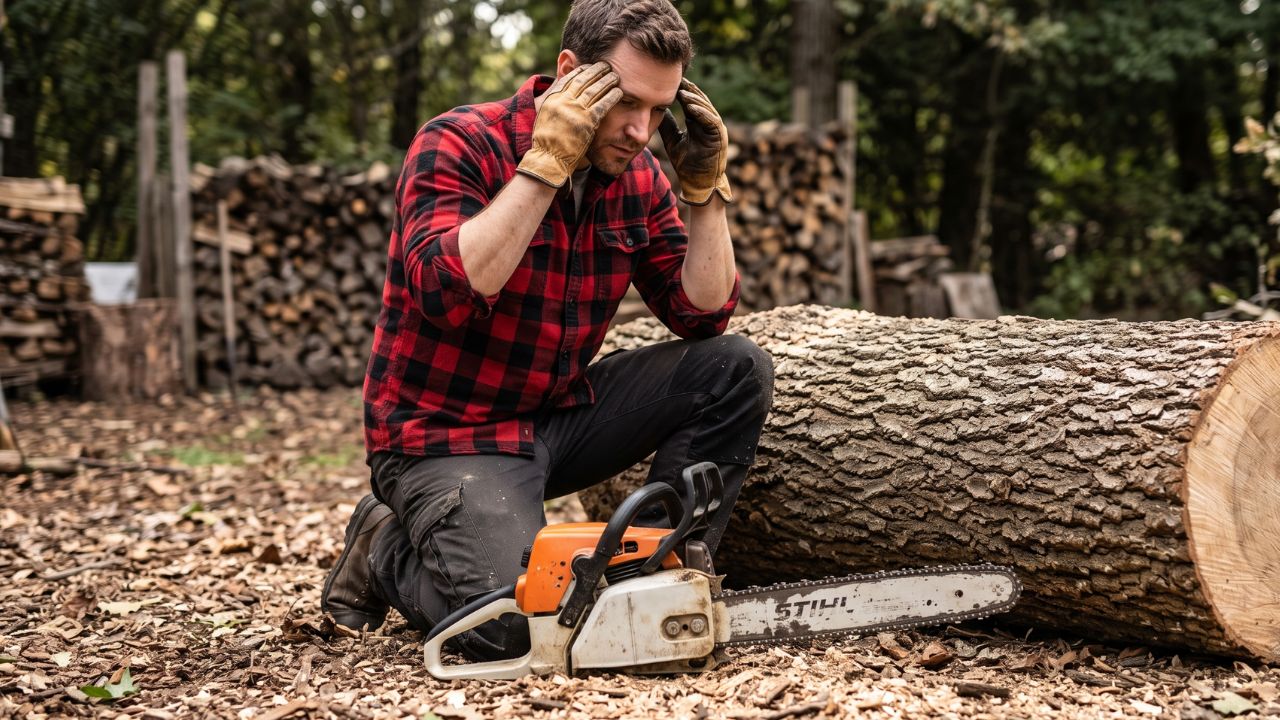
I remember the frustration perfectly. I stood in my yard facing a massive oak log. My saw started on the first pull. It idled smoothly and sounded great. But then, the chainsaw dies when I give it gas. It just bogged down, made a hollow sound, and quit completely. I pulled the cord again. It started and idled just fine. But the second I squeezed the trigger, it died all over again. I wanted to throw the tool right across the yard.
Instead, I sat down on the log and decided to figure it out. This is an incredibly common problem for anyone who cuts wood. You do not need to be a small engine mechanic to solve it. Over the years, I learned the exact steps to get my saws running strong again. You will learn the common causes, my favorite quick fixes, and the simple mistakes I made along the way. Let us fix your saw together.
Why My Chainsaw Dies When I Give It Gas
An engine needs a perfect balance to run correctly. It requires clean air, fresh fuel, and a strong spark. At idle, the saw uses a tiny sip of fuel. When you pull the trigger, the engine suddenly demands a massive rush of gas and air to spin the chain.
If that rush of gas does not arrive in time, the saw chokes. The delicate balance breaks instantly. This is why the saw stalls under a heavy load. It is almost always a fuel delivery problem or an airflow restriction.
| Problem Symptom | What Is Happening Inside |
| Idles fine but bogs on throttle | Carburetor is set too lean |
| Starts fast then slowly fades | Fuel filter is totally blocked |
| Sounds muffled and dies down | Spark arrestor screen is plugged |
The Carburetor Starves for Fuel
The carburetor is the mechanical heart of your saw. Its only job is to mix liquid gas with outside air. Over time, the tiny microscopic ports inside the carb get sticky. Sawdust and dried fuel create a gummy mess.
When you hit the throttle, the carb tries to push fuel through those tiny holes. If they are blocked, the saw gets a giant gulp of plain air instead. Engines cannot run on just air. The spark plug fires, finds no fuel, and the engine stops spinning.
The Easy Fixes I Check Every Time
I used to tear my saw completely apart on day one. I thought every problem required a total engine rebuild. That was a massive waste of my time. Now, I always start with the absolute simplest things. These easy steps solve the stalling problem most of the time.
Dumping Out Stale Fuel
Modern gasoline is terrible for small engines. Most pump gas contains ethanol. Ethanol is basically alcohol, and it pulls moisture right out of the damp air. This water sinks directly to the bottom of your gas tank.
If your mixed gas sits in a plastic can for two months, it goes completely bad. It smells like old varnish. My saw kept bogging down one spring. I finally dumped the tank out. I mixed a brand new batch of premium gas and high-quality oil. The saw fired up and ran flawlessly. Always try fresh gas before you buy any parts.
Cleaning the Spark Arrestor Screen
This tiny metal screen is hidden safely inside your muffler. Its job is to stop hot exhaust sparks from flying out and starting a forest fire. It is a great safety feature, but it causes huge headaches.
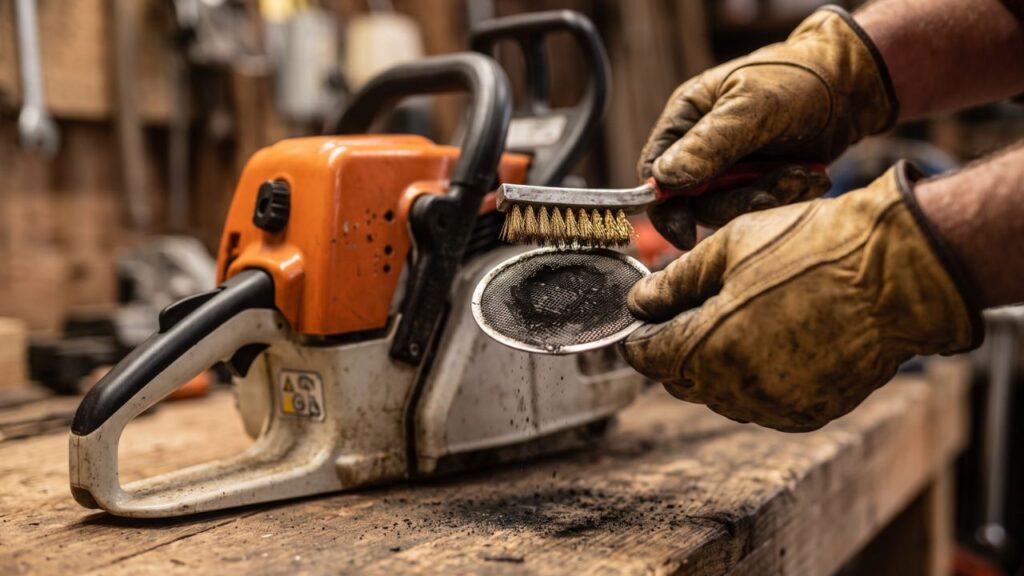
Over time, unburned two-stroke oil and soot build up on the metal mesh. It forms a thick, hard black crust. The exhaust simply cannot flow out of the engine. If the exhaust cannot leave, fresh air cannot enter. The saw suffocates the moment you demand more power. I remove the small holding screw, pull the screen out with pliers, and inspect it.
| Screen Condition | My Troubleshooting Solution |
| Clean and silver metal | Leave it exactly as it is |
| Light soot and dust buildup | Scrub clean with a wire brush |
| Covered in thick black carbon | Heat with a torch to burn it clean |
Checking for a Dirty Air Filter
Cutting dead wood creates endless amounts of dust. That fine dust swirls right around your hands and your saw. The air filter is designed to catch it before it destroys the engine cylinder. But a fully clogged filter acts like a wall.
It completely blocks the air flow. If the saw gets its normal dose of gas but no air, it floods. It will bog down thick and shut off. I pop the plastic top cover off and look closely at the filter. I tap it hard on a wooden bench to knock the heavy dust loose. If it is very greasy, I wash it gently with warm soapy water and let it dry.
Fuel Line Issues: When the Chainsaw Dies When I Give It Gas
If the air filter is clean and the exhaust is clear, the issue points directly to fuel. The gas has a long journey from the plastic tank to the engine block. Any blockages or leaks along the way will cause major stalling. Let us trace the fuel lines together.
Swapping the Old Fuel Filter
You will find the fuel filter hiding deep inside the gas tank. It sits securely at the end of a flexible rubber hose. It needs to roll around the bottom of the tank to drink fuel from any angle.
After a year or two of hard use, this filter gets incredibly hard. It gets packed solid with tiny bits of wood, dirt, and plastic shavings. It simply cannot suck up fuel fast enough for high speeds. I use a piece of stiff wire bent into a hook to pull it out of the tank neck. They are very cheap to replace. I just pull the old one off the hose and push a brand new one on.
| Old Filter Signs | New Filter Traits |
| Hard and brittle outer plastic | Soft and heavy porous material |
| Dark brown, black, or yellowed | Bright white or clean silver |
| Restricts the liquid gas flow | Absorbs liquid fuel instantly |
Hunting for Cracked Fuel Lines
Rubber fuel lines dry out as they age. They get brittle and stiff. The constant, violent vibration of a running saw rubs them directly against sharp metal edges. Soon, a tiny invisible crack forms in the rubber.
When you hit the gas, the fuel pump works very hard to draw fuel. But instead of pulling heavy gas from the tank, it takes the easy route. It sucks empty air through that tiny crack. The engine starves immediately and dies. I inspect the rubber lines very closely. I pinch them gently with my dirty fingers. If they feel stiff or show tiny stress lines, I replace the whole set.
Black and Decker Mini Chainsaw
The Hidden Impulse Line Problem
This is a secret issue that confused me for years. Besides the main fuel line, there is another hose called the impulse line. It connects the engine crankcase directly to the carburetor.
As the engine piston moves up and down, it creates pulses of air pressure. This pressure travels through the impulse line to operate the fuel pump inside the carb. If this specific rubber line tears or falls off, the fuel pump completely stops working. The saw might idle on leftover gas, but it will die the second you need power. I always check to make sure this line is securely attached.
How I Tune the Carburetor Without Fear
Carburetors intimidate a lot of people. I used to pay a local shop good money just to tune my saws. Then I learned how simple it really is in practice. You just need a very small screwdriver, ear protection, and a quiet place to listen to the engine.
Understanding the L, H, and T Screws
Look closely at the left side of your saw housing. You will see three small adjustment holes stamped into the plastic. They are usually marked L, H, and T. These tiny screws control exactly how much fuel enters the engine at different speeds.
Turning a screw to the right (clockwise) makes the fuel mixture leaner. Turning it to the left (counter-clockwise) makes the mixture richer. Modern saws sometimes require a special splined tool to turn them, which you can easily buy online.
| Screw Name | What It Controls in the Saw |
| L (Low Speed) | Fuel flow at idle and early throttle jump |
| H (High Speed) | Fuel flow at maximum wide-open throttle |
| T or LA (Idle) | How fast the chain spins while at a rest |
Adjusting the L Screw for Better Acceleration
When my chainsaw dies when I give it gas, the L screw is my very first target. The L screw handles the critical jump from a low idle to full cutting power. If it is set slightly too lean, the engine stalls violently on acceleration.
I start the saw and let it warm up for five full minutes. Then, I put my screwdriver on the L screw. I turn it to the left (counter-clockwise) just a tiny hair. I imagine a clock face and turn it maybe five minutes worth of distance. Then I quickly squeeze the throttle trigger. If the saw revs up smooth and loud, I stop right there. If it still bogs, I turn it another tiny hair. This simple tweak solves the stalling issue almost every single time.
Hidden Problems I Discovered Over Time
Sometimes the usual tuning tricks fail completely. I spent an entire rainy weekend fighting a saw that refused to run right. I checked the carb, replaced the lines, and washed the filter. Nothing worked at all. Then I discovered some hidden problems that most manuals skip over.
The Clogged Gas Cap Vent
A plastic gas tank must breathe to work properly. As liquid fuel leaves the tank, outside air must flow in to replace the lost volume. Gas caps have tiny, intricate vents built into them to let this air in.
Sawdust and sticky bar oil love to plug these tiny vents. When the vent blocks totally, a strong vacuum builds up inside the tank. The saw runs great for about five minutes. Then, the vacuum becomes stronger than the fuel pump. It pulls the fuel backward. The saw starves and quits. I test this simply by loosening the gas cap slightly. If the saw suddenly runs perfectly again, I know the cap vent is ruined.
| Cap Vent Test | What It Tells Me |
| Saw stalls with cap tight | The tank is building a dangerous vacuum |
| Saw runs great with cap loose | The cap vent is fully plugged with dirt |
| Saw stalls even with cap loose | The problem is located in the carburetor |
Stiff Carburetor Diaphragms
Inside the metal carburetor sits a paper-thin rubber flap. It is called a metering diaphragm. It pulses rapidly back and forth to pump gas into the engine. It is highly flexible when new.
After a few years, sitting in ethanol gas turns this soft rubber into hard, crispy plastic. It loses its ability to pulse. It physically cannot pump enough fuel when you demand high power for cutting. If adjusting the tuning screws does nothing, I know I need a carb rebuild kit. I lay out a clean white towel on my bench. I remove the old carb parts in order, taking photos with my phone. I replace the old stiff rubber with fresh parts. It takes twenty minutes and gets the saw running like new.
Mistakes I Made When Troubleshooting
Troubleshooting small engines takes a lot of practice. I did a lot of dumb things when I first started fixing my own saws. I want to save you the money and headaches I caused myself early on. Avoid doing these things when your saw starts acting up.
Twisting Screws Blindly
Early on, I grabbed a flathead screwdriver and just started twisting the carb screws everywhere. I was impatient. I did not count my turns at all. I completely ruined the factory tune in minutes.
The saw refused to start at all after my messing around. I had to take it to a professional dealer just to reset it. Now, I never turn a tuning screw without carefully counting. I turn it gently to the right until it seats lightly, counting the exact number of turns. I write that number down on a notepad. Then I make my tiny adjustments. If I mess up, I can always go right back to my safe starting point.
Forgetting to Check the Spark Plug
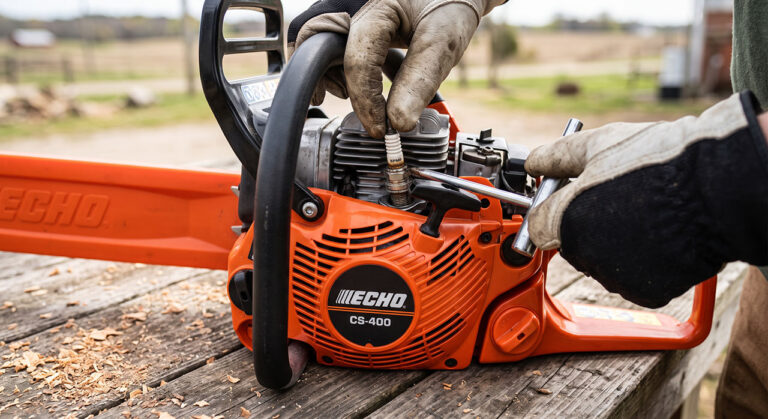
The spark plug is a clear window directly into the engine cylinder. I used to ignore it entirely. Now, pulling the plug is one of my very first diagnostic checks.
I pull the plug out and look closely at the firing tip. If the tip is wet and pitch black, the saw is getting way too much gas. It is flooding out. If the tip is ash white or blistered, the saw is heavily starving for gas. It is running terribly hot. I want to see a nice light tan or cardboard color. Spark plugs are incredibly cheap. I keep a spare in my toolbox at all times.
| Plug Tip Color | What It Means for the Saw |
| Wet and dark black | Running rich and getting far too much fuel |
| Bright white or gray | Running lean and starving for needed gas |
| Light brown or tan | Running perfectly balanced and healthy |
The Danger of Hidden Air Leaks
This is the worst-case scenario for any chainsaw owner. If you rebuild the carb, change the lines, use fresh gas, and the saw still dies, you might have an internal air leak. This is a very serious mechanical issue.
Air leaks let unmetered, wild air sneak directly into the engine block. This bypasses the carburetor entirely. It makes the engine run dangerously lean and incredibly hot. If left unchecked, the heat will literally melt the metal piston inside the cylinder, ruining the saw forever.
Crank Seals and Intake Boots
Air leaks always happen where soft rubber meets hot metal. The intake boot is a thick rubber tube connecting the carb to the engine cylinder. Extreme heat and age can crack it open. Air simply rushes right through the crack when you hit the throttle.
The other common spots are the rubber crank seals. These sit directly on the spinning engine shaft behind the flywheel and the clutch. Testing for air leaks requires blocking off the exhaust port and pumping air pressure into the engine with special tools. When I suspect a major air leak, I admit defeat. I take the saw directly to a professional shop. It is much better to pay for a fast pressure test than to completely destroy a heavy-duty engine.
How I Stop This From Happening Again
Fixing a broken saw is satisfying, but preventing the problem is much better. Over the years, I developed a few simple habits that stop my saws from bogging down in the first place. These small steps save me hours of frustration.
Running the Saw Dry Before Storage
If I know I will not cut wood for a few months, I never leave fuel in the tank. Letting ethanol gas sit in the dark over the winter is a guaranteed way to ruin the fuel lines and stiffen the carburetor diaphragms.
I take the saw outside and dump the remaining gas out of the tank. Then, I start the saw up and let it idle normally. I let it run until it completely runs out of gas and stalls on its own. I pull the choke and pull the cord a few more times to get every last drop out of the carburetor. Storing the saw totally dry keeps the internal rubber parts safe.
Using Ethanol-Free Pre-Mixed Fuel
This habit changed everything for my small engines. I stopped buying cheap gas from the corner station for my chainsaws. I now buy the metal cans of pre-mixed, ethanol-free fuel from the hardware store.
Yes, it costs a little more money upfront. But it lasts for years on the shelf without going bad. It never pulls water from the air. It never rots my fuel lines. Since I switched to premium canned fuel, I almost never have to rebuild my carburetors anymore. It is worth every single penny in saved frustration.
Final Thoughts
Fixing a chainsaw that stalls under a load is mostly about patience. Whenever my chainsaw dies when I give it gas, I force myself to start with the simplest causes first. I check for fresh fuel, clean out the air filters, and make sure the tiny spark arrestor is clear. Usually, one of these five-minute checks gets me right back to cutting wood without spending a dime. If those fail, a tiny left turn to the low-speed carburetor screw almost always does the trick.
Do not let small engine repair intimidate you. I ruined a few cheap parts when I first started, but I learned very fast by doing it myself. Keep your workbench clean, take your time, and pay close attention to what the engine is telling you. If you keep up with basic cleaning and use good fuel, your saw will run strong for many years. Stay safe in the woods and enjoy making sawdust.