How to Fix a Flooded Chainsaw: Fast Methods That Work
I still remember standing in the woods, yanking the starter cord on my saw until my shoulder burned. The air smelled strongly of raw gas, and my frustration was through the roof. I had a massive pile of oak to cut, but my machine simply refused to start. That was the day I had to sit down, take a breath, and figure out how to fix a flooded chainsaw before I ruined my equipment or my back.
Learning how to clear a flooded engine is a right of passage for anyone who cuts firewood or clears brush. It happens to the best of us, usually because we miss the tiny “pop” the saw makes when it is ready to start. If you keep pulling the cord with the choke on, you will drown the engine in fuel. Luckily, getting that liquid out is actually a very simple process once you know the tricks. I want to share the exact steps I use to get my saw running again in just a few minutes.
How Do You Even Flood a Chainsaw?
To fix the problem, it helps to know what just happened inside your tool. When you pull the choke out, you are cutting off the air supply.
This forces the carburetor to suck pure liquid fuel into the engine block. You need this rich mix of gas to wake up a cold engine. But an engine can only burn gas when it is mixed with air. If you pull the starter rope too many times with the choke on, the tiny spark plug gets soaking wet. A wet spark plug cannot create a spark. Without a spark, the gas just sits in the cylinder, and your saw is officially flooded.
Telltale Signs Your Saw is Flooded
Before you start taking things apart, you need to be sure the engine is actually flooded. Over the years, I have noticed a few dead giveaways.
The most obvious sign is the smell. If you are standing over the saw and you can smell fresh, unburned gasoline, you have a flood on your hands. Another big clue is how the starter cord feels. When the cylinder is full of liquid, the compression changes. The cord might feel slightly easier to pull, or it might just sound “mushy” instead of having that crisp, mechanical turning sound.
| What You Notice | What It Means |
| Strong smell of raw gas | Fuel has bypassed the combustion chamber. |
| Cord pulls easily with a dull sound | The spark plug is soaked and failing to fire. |
| Liquid dripping from the muffler | Severe flooding. The engine block is completely full. |
The Fast Way to Fix a Flooded Chainsaw
Most of the time, you do not need any tools to fix this. You just need to change how you are trying to start the saw.
This fast method works for me about ninety percent of the time. It is all about getting maximum air into the engine to dry out the wet fuel.
Step 1: Push the Choke All the Way In
The very first thing you must do is turn off the choke.
If you leave the choke on, every pull of the rope just adds more gas to the problem. Push the choke knob all the way in to the “run” position. This opens the air flap in the carburetor. You want as much fresh air as possible to flow into the engine block.
Step 2: Pin the Throttle Wide Open
This step is the secret to the whole trick. You need to hold the throttle trigger down completely.
Put your boot in the rear handle of the saw to hold it steady on the ground. Use one hand to squeeze the throttle trigger wide open. Some saws have a “fast idle” lock you can set, which makes this easier. If yours does not, just squeeze it tight. Opening the throttle tells the carburetor to let massive amounts of air rush through the system.
Step 3: Pull the Cord Vigorously
With the choke off and the throttle wide open, grab the starter rope.
Pull the cord fast and hard. You might have to pull it five, ten, or even fifteen times. Your arm will get tired, but keep going. Eventually, the excess gas will blow out through the exhaust. The saw will cough, sputter, blow a cloud of blue smoke, and roar to life. As soon as it starts, let go of the throttle so the chain stops spinning.
| Action | Why It Works |
| Choke pushed in | Stops pulling new fuel into the engine. |
| Throttle squeezed open | Lets maximum air in to dry the spark plug. |
| Rapid, repeated pulls | Forces the liquid gas out through the muffler. |
The Deep Clean Method for Stubborn Saws
Sometimes the fast method just does not work. If you pulled the cord twenty times with the choke on, the engine is drowning.
When my saw is severely flooded, pulling the cord with the throttle open is not enough. The spark plug is so wet that it cannot dry out just from airflow. When this happens, I have to open up the saw and do a manual deep clean. You will need your scrench (the combination screwdriver and wrench that came with your saw) or a basic socket set.
Removing the Spark Plug
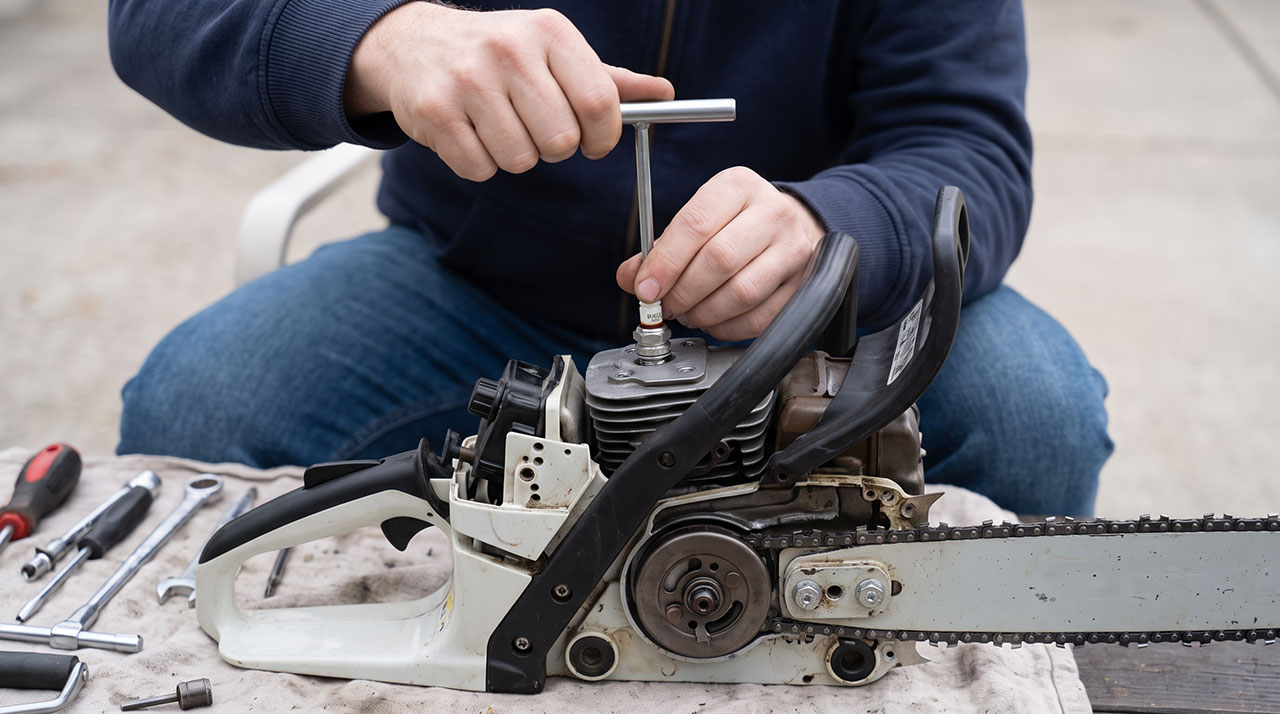
Take the top plastic cover off your chainsaw to expose the engine cylinder.
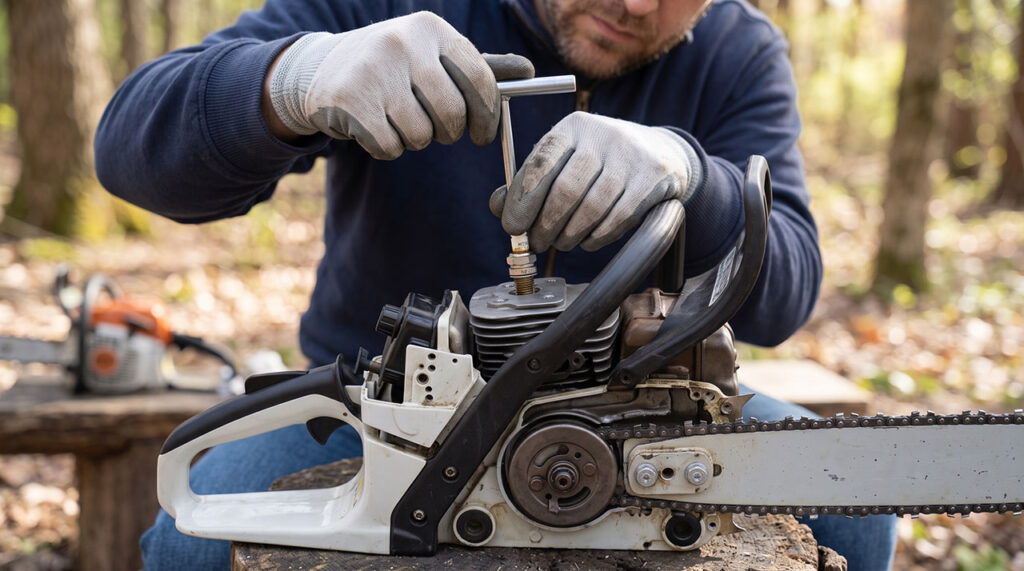
Pull the rubber boot off the top of the spark plug. Use your wrench to unscrew the spark plug completely. When you pull it out, look at the tip. I can almost guarantee it will be dripping black, oily gas. Wipe the plug completely dry with a clean rag. If the metal contacts look burned or heavily coated in black carbon, you might just want to put a brand new plug in.
Purging the Cylinder
Now you need to get the liquid gas out of the empty engine block.
Turn the chainsaw upside down so the empty spark plug hole is pointing at the ground. Make sure the ignition switch is turned to the “off” position for safety. Pull the starter cord slowly a few times. You will likely see liquid gas spit right out of the hole onto the ground. Keep pulling until no more liquid sprays out.
Putting It Back Together
Once the cylinder is clear, leave the saw sitting for about ten minutes.
This gives the remaining gas fumes time to evaporate into the air. After a short break, screw your dry spark plug back in. Tighten it up, push the rubber boot back on, and put the plastic cover back in place. Now, try starting the saw normally, but leave the choke completely off. It should fire right up.
| Deep Clean Step | Why It Matters |
| Wiping the spark plug | Removes the liquid barrier stopping the spark. |
| Flipping the saw upside down | Lets gravity help drain the heavy liquid gas. |
| Waiting ten minutes | Allows trapped fuel vapors to naturally evaporate. |
Mistakes I Made That Caused Flooding
I used to flood my chainsaw all the time when I first started cutting wood. I did not understand how sensitive two-stroke engines can be.
Looking back, I was making a few very common beginner mistakes. Changing my starting habits completely solved my flooding issues. I want to share these mistakes so you can avoid the frustration I went through.
Ignoring the Engine Burp
This is the number one reason people flood their chainsaws.
When you start a cold saw with the choke on, it will not fully start. It will just “burp” or make a quick popping sound, and then instantly die. That pop is the saw telling you it has enough fuel. I used to ignore that pop and just keep pulling the cord. If you pull even one more time after that burp with the choke on, you will flood the engine. You must push the choke in immediately after hearing that sound.
Using Old, Gummy Fuel
Bad gas is a chainsaw’s worst enemy.
Gasoline breaks down very quickly, especially when mixed with two-stroke oil. If your gas is more than thirty days old, it starts to turn into a sticky varnish. Old gas makes the saw incredibly hard to start. Because it will not start easily, you naturally pull the cord more times with the choke on, which leads straight to a flooded engine. I always use fresh gas, and I add a fuel stabilizer if the saw will sit for a while.
| Mistake | Better Approach |
| Pulling cord after the “pop” | Push choke to half or off the second you hear it fire. |
| Using fuel from last season | Mix small, fresh batches of gas every month. |
| Yanking the cord frantically | Pull smoothly to feel for engine resistance. |
Dealing with Weather-Related Starting Issues
The temperature outside completely changes how your chainsaw behaves.
I have noticed that my saws start completely differently in the dead of winter compared to the middle of a hot summer. Knowing how to read the weather will save you a lot of time and shoulder pain.
Winter Starting Realities
Cold weather makes gas thicker and harder to vaporize.
In the winter, a cold chainsaw actually needs a very rich fuel mixture to wake up. You might have to pull the cord four or five times on full choke before you hear that starting burp. The risk of flooding is lower in the winter, but it still happens if you lose count of your pulls.
Hot Weather and Vapor Lock
Summer heat brings a totally different problem that mimics a flooded chainsaw.
If you have been running the saw hard, turn it off to load some logs, and try to start it ten minutes later, it might refuse to fire. You might assume it is flooded. However, this is often “vapor lock.” The heat of the engine causes the gas in the carburetor to boil and turn into vapor. The fix is actually the same. Hold the throttle wide open, skip the choke entirely, and pull the cord until the fresh liquid gas pushes the hot vapor out.
| Scenario | Best Starting Practice |
| Freezing cold mornings | Use full choke until the very first sign of a pop. |
| Restarting a hot saw | Never use the choke. Just pull the cord normally. |
| Hot saw refusing to start | Hold throttle wide open to clear vapor lock. |
Sneaky Issues That Look Like a Flooded Chainsaw
Sometimes you go through all the steps to clear a flooded engine, and the saw still refuses to start.
When this happens, the problem is usually not fuel at all. It is easy to blame a flooded engine when the real issue is hiding somewhere else. I have wasted hours pulling a starter cord, convinced my saw was flooded, only to find a different mechanical failure.
A Dead Spark Plug
Spark plugs do not last forever.
Over time, the ceramic cracks or the metal tip gets covered in thick carbon deposits. A dead spark plug acts exactly like a flooded engine. You pull the cord, it smells like gas, but nothing happens. If you do the deep clean method and your dry plug still will not fire, test the spark. Take the plug out, plug it into the rubber boot, and touch the metal threads against the engine block. Pull the cord and look for a bright blue spark. If there is no spark, buy a new plug.
Clogged Spark Arrestor Screen
This is a tiny detail that causes massive headaches.
Inside your chainsaw’s muffler, there is a small metal mesh screen called a spark arrestor. It stops hot sparks from flying into dry grass and starting a fire. If you use cheap oil, or run your saw too gently, this screen gets totally clogged with black soot. When the exhaust cannot escape, the engine cannot breathe, and it will flood itself trying to start. I check my screen once a season and burn the soot off with a propane torch if it looks clogged.
| Symptom | Likely Cause |
| Strong gas smell, no spark on test | Faulty or burned out spark plug. |
| Saw starts briefly, then suffocates | Clogged spark arrestor screen in muffler. |
| Gas dripping heavily from air filter | Stuck needle valve inside the carburetor. |
Final Thoughts
Learning how to fix a flooded chainsaw is mostly about patience and understanding what your machine is trying to tell you. Every saw has its own unique personality and its own specific starting sounds. Once I stopped rushing and started actually listening for that quick engine pop, my flooding problems almost entirely disappeared. Now, starting my saw feels like second nature rather than a gamble.
If you are currently fighting a flooded engine, do not stress about it. Push that choke in, pin the throttle wide open, and give it a few solid pulls. If that fails, grab your wrench and dry out the spark plug. Mechanical problems can be frustrating, but they are always solvable. Take care of your saw, use fresh fuel, and it will take care of you out there in the woods.