Husqvarna Chainsaw Starting Problems: How I Finally Fixed Mine

I remember standing in the woods, yanking the pull cord on my saw until my shoulder ached. Dealing with Husqvarna chainsaw starting problems can turn a great day of cutting into a massive frustration. You just want to clear some brush or cut firewood, but your saw simply refuses to cooperate.
Over the years, I have spent a lot of time tearing down my saws on the tailgate of my truck. I learned that fixing a stubborn saw does not require a degree in small engine repair. By understanding how fuel, air, and spark work together, I figured out how to diagnose and fix these issues myself. In this guide, I will share exactly what I look for when my saw will not fire, the mistakes I made along the way, and how you can get your chainsaw running smoothly again.
Diagnosing Husqvarna Chainsaw Starting Problems
When my saw dies or refuses to turn over, I always stop and take a breath. It is incredibly tempting to just keep pulling the cord, but that usually makes things worse.
I always start by looking at the most basic things. An engine needs three things to run: fuel, air, and spark. If any of those are missing, the saw will sit there dead. I like to run through a quick mental checklist before I start ripping pieces off the machine.
| Symptom | Likely Cause | My First Step |
| Smell of raw gas | Flooded engine | Clear the cylinder |
| Cord pulls very easily | Low compression | Check spark plug tightness |
| Saw pops but dies | Choke left on too long | Push choke in, pull again |
The Curse of Stale Gas
I used to leave gas in my saw over the winter, thinking it would be fine. That was a huge mistake that cost me hours of repair time.
Modern gasoline usually contains ethanol. Ethanol absorbs moisture from the air, and over time, it breaks down. After about thirty days, untreated fuel starts to turn into a sticky varnish. This varnish clogs the tiny passages in the carburetor. Now, whenever my saw will not start after sitting for a while, the very first thing I do is dump the old gas. I mix a fresh batch of high-quality two-stroke fuel, and nine times out of ten, the saw fires right up.
Dealing With a Flooded Engine
Flooding the engine is the easiest mistake to make, especially when you are in a rush. I have done it more times than I care to admit.
A flooded engine happens when too much fuel gets trapped in the combustion chamber. The spark plug gets wet, and it cannot create a spark. You will usually know it is flooded because you will smell unburned gas coming from the exhaust. When this happens to me, I do not panic. I simply take a few steps to clear it out.
| Problem | Quick Solution |
| Wet spark plug | Remove plug, wipe dry, pull cord to clear gas |
| Choke flooded engine | Push choke completely off, hold throttle wide open, pull |
| Excess gas in cylinder | Let the saw sit for 15 minutes to evaporate |
Step-by-Step Troubleshooting for Stubborn Saws
If fresh gas and a cleared engine do not work, it is time to grab some basic tools. Do not worry; you do not need to be a mechanic for this part.
I keep a simple tool kit in my chainsaw case just for these moments. Usually, the tool that comes with the Husqvarna (the scrench) is all I need to do a full check in the field.
Checking the Spark Plug First
A dirty or fouled spark plug is incredibly common. I always keep a brand new, gapped spark plug in my saw case for this exact reason.
To check the plug, I pull off the rubber boot and use my scrench to unscrew the plug. If the tip is black, crusty, or soaking wet, that is likely the problem. I like to test the spark by plugging the boot back onto the loose spark plug. I touch the metal side of the plug to the metal engine block, make sure the saw switch is “On,” and pull the cord. If I see a bright blue spark, the plug is good. If there is no spark, or if it is weak and yellow, I swap in my spare.
Inspecting the Air Filter
Chainsaws kick up a massive amount of sawdust, and a lot of it goes straight for your air intake. A choked-out saw simply will not run.
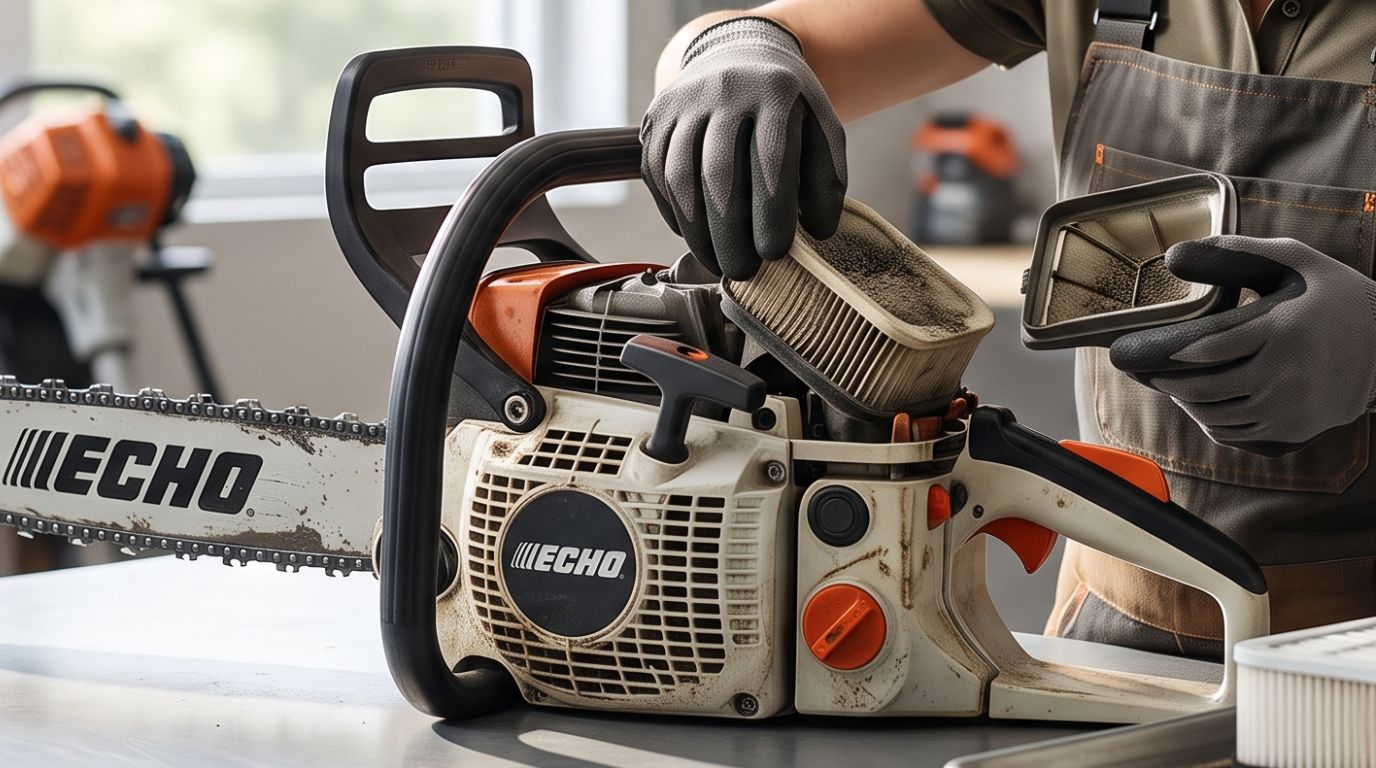
I used to ignore my air filter until the saw started bogging down. Now, I check it constantly. To check it on a Husqvarna, I pop off the top cover. The air filter sits right above the carburetor. If it is caked in fine dust, the engine cannot breathe. I usually tap it gently against my boot to knock the heavy dust loose. If it is really dirty, I wash it with warm, soapy water at home and let it dry completely before putting it back.
| Component | What to Look For | Action Needed |
| Spark Plug | Black carbon or wet fuel | Clean or replace plug |
| Air Filter | Thick layer of sawdust | Tap clean or wash |
| Fuel Filter | Discolored or stiff | Fish out of tank and replace |
Digging Deeper: When Basic Fixes Fail
Sometimes the easy fixes do not solve the issue. If I have confirmed I have a good spark, a clean air filter, and fresh fuel, I know I have to look slightly deeper into the machine.
Do not let this intimidate you. These next steps are just as straightforward, even if they take a few more minutes to complete.
The Hidden Spark Arrestor Issue
For the longest time, I did not even know what a spark arrestor was. I thought my saw was totally dead, but it was just suffocating from a tiny clogged screen.
The spark arrestor is a small wire mesh screen located inside or just behind the muffler. Its job is to stop hot sparks from flying out and starting a forest fire. Over time, especially if you mix your oil a bit too rich, this screen gets plugged up with black carbon. When the exhaust cannot escape, the engine cannot run. I take off the muffler cover, pull out the little screen, and hold it with pliers. I use a small propane torch to burn the carbon off. Once it is clean and you can see light through the mesh, I put it back in. It is amazing how often this fixes a dead saw.
Carburetor Woes and Fuel Lines
If your saw starts for a second and dies, or if it will not prime at all, the carburetor or fuel lines might be the culprit.
Fuel lines rot over time, again, mostly due to ethanol in the gas. I shine a flashlight into the fuel tank. If the little black or clear hose looks cracked, brittle, or has fallen apart, it is sucking air instead of fuel. Replacing fuel lines is cheap and only takes a few minutes with needle-nose pliers. Inside the carburetor itself, there are thin rubber diaphragms that pump the fuel. If they sit dry for too long, they get stiff. Rebuilding a carb sounds scary, but it is really just removing four screws and swapping out two tiny rubber gaskets.
| Scenario | Recommendation |
| Primer bulb stays flat | Replace cracked fuel lines |
| Saw idles but dies when revved | Tune the High/Low carb screws |
| Saw sat dry for 3 years | Buy a cheap carb rebuild kit |
The Correct Starting Procedure
I realized eventually that half of my Husqvarna chainsaw starting problems were actually my own fault. I simply was not starting the machine correctly.
Every saw has a specific rhythm. If you get out of rhythm, you flood the engine. I had to unlearn my bad habits and follow the exact procedure Husqvarna recommends. It made a world of difference.
More Article How to Start a 026 Stihl Chainsaw
The Cold Start Routine
Starting a saw that has been sitting overnight requires a very specific sequence. If you skip a step, you will be pulling the cord all day.
Here is the exact method I use now. First, I engage the chain brake for safety. Then, I press the primer bulb five or six times until fuel flows through it. Next, I pull the choke lever all the way out. I hold the saw firmly on the ground, put my foot through the rear handle, and pull the cord. I pull it only until the engine makes a brief “pop” or “burp” sound. This is the most crucial part. The moment it pops, I push the choke back in. Then, I pull the cord again, and it usually starts on the very next pull.
The Hot Start Routine
Trying to start a saw that is already warm using the cold start method is a guaranteed way to flood it. I learned this the hard way after stopping for a water break.
If I have been cutting and just shut the saw off for a few minutes, I do not touch the choke at all. I just leave the switch in the “On” position and pull the cord. If it has been sitting slightly longer and cooled down just a bit, I might use the “fast idle” trick. I pull the choke out, then immediately push it back in. This sets the throttle a bit higher without choking the air supply.
| Starting State | Choke Position | Primer Bulb Action |
| Cold Engine | Fully Out (On) | Press 5-6 times |
| Warm Engine | Fully In (Off) | Do not press |
| Flooded Engine | Fully In (Off) | Do not press |
Mistakes I Made Trying to Fix My Saw
I have made my fair share of errors trying to force a stubborn chainsaw to run. Learning the hard way taught me what to avoid when I am out in the field.
Frustration is your worst enemy when working on small engines. When I get mad, I start yanking the cord harder, tweaking screws I should not touch, and breaking plastic parts. Now, I try to step back and think logically.
| Myth | Reality |
| Pulling the cord harder makes it start | Smooth, steady pulls save your starter mechanism |
| More oil in the fuel mix is safer | Too much oil fouls the plug and clogs the exhaust |
| Adjusting carb screws fixes everything | Carb adjustments rarely fix a dirty filter or bad gas |
Fiddling with the Carburetor Unnecessarily
Whenever my saw ran poorly, my first instinct was to grab a tiny screwdriver and start turning the tuning screws on the carburetor. This was a terrible habit.
The factory settings on a Husqvarna carburetor are usually perfectly fine. By blindly turning the High (H), Low (L), and Idle (T) screws, I threw the fuel mixture completely out of balance. My saw would scream too fast or bog down and die. I learned that you should only touch those screws if you have a tachometer and know exactly what you are doing. Most of the time, a bad idle is caused by a dirty air filter or an air leak, not the carburetor tuning.
Using Cheap Oil and Gas
I used to buy the cheapest pump gas I could find and whatever two-stroke oil was on sale at the hardware store. It seemed like a smart way to save money.
I quickly realized that cheap fuel destroys small engines. Cheap two-stroke oil leaves a ton of carbon buildup inside the engine cylinder. Now, I exclusively buy high-octane, ethanol-free gasoline. It costs a bit more at the pump, but it completely eliminated my fuel line rot. I also switched to Husqvarna’s synthetic blend oil. It burns much cleaner, and my spark plugs last twice as long.
Daily Habits to Prevent Starting Issues
An ounce of prevention really is worth a pound of cure. These are the routines I follow now to ensure my saw starts easily every single time I need it.
Taking five minutes at the end of a cutting day to care for my saw saves me hours of headache the next time I pull it out of the shed. It is just about building good habits.
| Good Habit | Why It Helps |
| Empty fuel for storage | Prevents varnish buildup in the carburetor |
| Clean air filter daily | Ensures optimal air-to-fuel ratio |
| Check chain tension | Prevents clutch damage that mimics engine stalling |
The End-of-Day Cleanup
When I am done cutting firewood, I do not just toss the saw in the back of the truck. I take a few moments to clean it up.
I use a cheap paintbrush to wipe away all the sawdust around the air filter and the cooling fins on the engine block. If sawdust cakes on the engine fins, the saw overheats, which can cause the engine to seize or stall when hot. I also wipe down the area around the gas cap before I open it. You never want dirt falling into your fuel tank.
Proper Long-Term Storage
Winter storage used to be the death of my chainsaws. Now, I have a strict routine for putting my saws away for the season.
I pour all the mixed gas out of the tank and back into my fuel can. Then, I start the chainsaw and let it idle until it completely runs out of gas and dies. This ensures the carburetor is totally dry. Finally, I remove the spark plug, squirt a tiny drop of fresh two-stroke oil directly into the cylinder, and pull the cord slowly one time to coat the metal walls. I put the plug back in, and the saw sleeps happily all winter.
Final Thoughts
Dealing with Husqvarna chainsaw starting problems can be incredibly annoying, but fixing them is completely within your abilities. I used to dread a saw that would not start, but now I view it as a simple puzzle. Most of the time, the fix is as simple as dumping out bad gas, drying off a wet spark plug, or cleaning out a dirty screen. You do not need to be a professional mechanic to keep your tools running well.
The biggest lesson I have learned is to trust the process and stay calm. If you follow the correct starting procedure, use high-quality ethanol-free fuel, and keep your filters clean, your saw will treat you right. Take care of your equipment, practice a little basic maintenance, and you will spend a lot less time pulling the cord and a lot more time cutting wood.