Poulan Chainsaw Starts But Dies When I Give It Gas
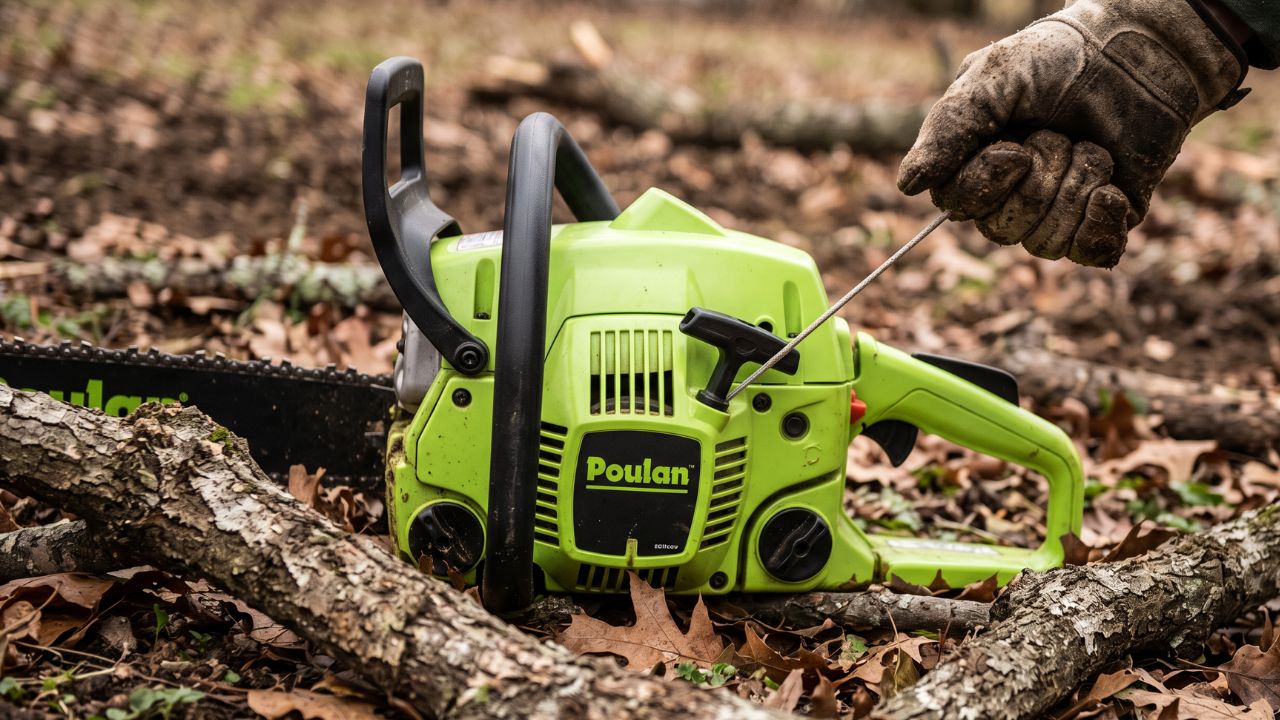
Few things are more frustrating than a yard full of downed branches and a chainsaw that refuses to cooperate. You prime it, pull the cord, and it fires up. It idles perfectly. But the second your poulan chainsaw starts but dies when i give it gas, you are left staring at a useless tool. I have been there more times than I care to admit.
When my Poulan first started doing this, I thought the engine was blown. I almost threw it away. But after a lot of trial, error, and dirty hands, I learned that this specific problem is rarely a death sentence for the saw. It is almost always a fuel delivery issue. Here is exactly how I learned to track down the problem and fix it in my own garage.
The Classic Bog Down: Why Is This Happening?
When your chainsaw idles smoothly, it means the spark plug is firing properly and the engine has enough compression to run. The idle circuit is doing its job.
The problem happens when you squeeze the throttle. Doing this opens a valve in the carburetor to let in a massive rush of air. To match that air, the carburetor must instantly supply a rush of fuel. If the fuel falls behind, the engine gets too much air and not enough gas. The saw makes a hollow “bwaaaah” sound, chokes, and stalls out completely.
Air, Fuel, or Spark? Narrowing It Down
I used to waste time changing spark plugs every time my saw acted up. I learned the hard way that if the saw starts and idles, the spark plug is fine. The ignition coil is fine. The issue is almost entirely on the fuel side of the equation.
| Symptom | What It Usually Means |
| Saw runs fine at idle, dies on throttle | Fuel starvation (carburetor or fuel lines) |
| Saw sputters and smokes heavily on throttle | Running too rich (too much fuel, not enough air) |
| Saw only runs with the choke halfway out | Clogged internal carburetor jets |
| Saw will not start at all | Spark, compression, or total fuel failure |
The Most Common Culprit: Carburetor Tuning Issues
The very first thing I check now is the carburetor tuning. Chainsaws vibrate violently. Over time, that vibration can actually cause the tiny adjustment screws on the side of the carburetor to back out or turn on their own.
Understanding the L and H Screws
If you look closely at the side of your Poulan carburetor, you will see two small adjustment screws. One is marked with an “L” for Low speed. The other is marked with an “H” for High speed. There is also a bigger screw for the idle speed, marked with a “T”. The L and H screws control how much fuel enters the engine.
| Screw Label | Function | Adjustment Trick |
| L (Low Speed) | Controls fuel from idle up to mid-throttle | Turn left slightly if saw dies upon hitting the gas |
| H (High Speed) | Controls fuel at wide-open full throttle | Turn left slightly if saw screams too loud at top speed |
| T (Idle Speed) | Controls how fast the chain spins at rest | Turn right if the saw keeps dying at a resting idle |
How I Tuned My Poulan Back to Life
Poulan makes tuning intentionally difficult. Instead of standard flathead screws, they use weird, splined screw heads. You cannot turn them with a normal screwdriver. I had to go online and buy a specific “21-tooth splined carburetor adjustment tool.” It cost me about ten bucks, but it was worth its weight in gold.
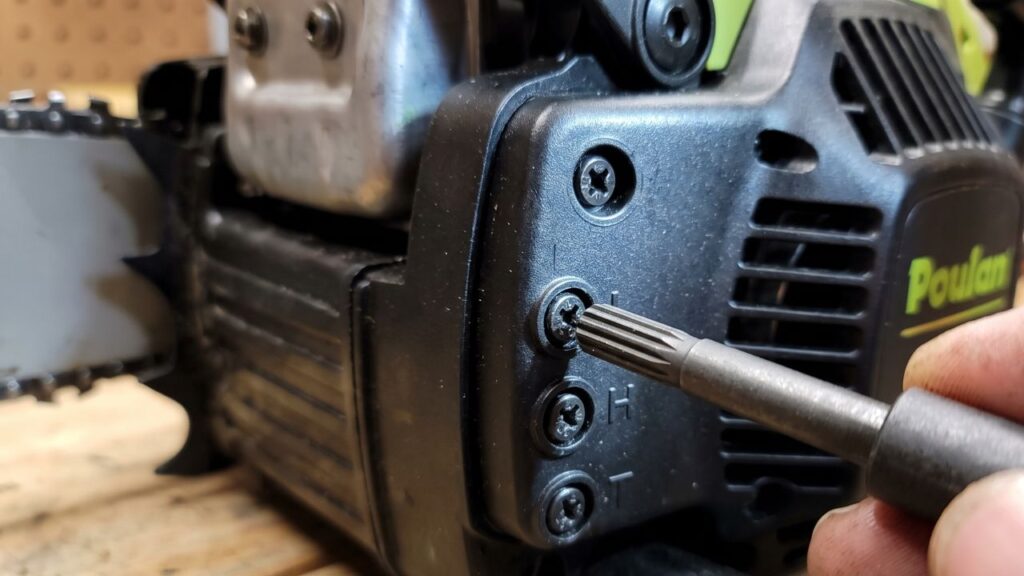
With the tool in hand, I started the saw and let it idle for a minute to warm up. Then, I put the tool on the “L” screw. I turned it counter-clockwise (to the left) just a tiny bit. Maybe an eighth of a turn. This opens the jet and allows more fuel to flow when you hit the gas. I squeezed the throttle, and the saw revved up perfectly. That tiny adjustment saved me a trip to the repair shop.
Best Chainsaw My Honest Review
Old Fuel and Clogged Lines
If tuning the carburetor does not work, the next thing I look at is the gas itself. Modern gasoline is terrible for small engines. I learned this lesson after leaving my saw in the shed from November to April without draining the tank.
The Ethanol Gas Nightmare
Most pump gas contains 10% ethanol. Ethanol attracts moisture from the air. Over a few months, water separates from the gas and sinks to the bottom of the fuel tank. Even worse, the ethanol turns into a sticky, gummy varnish that coats everything inside the fuel system.
| Gas Choice | Winter Result |
| Standard Pump Gas (10% Ethanol) | Turns gummy, rots fuel lines, clogs small jets |
| Ethanol-Free Canned Fuel | Stays fresh for years, keeps carburetor completely clean |
Checking the Fuel Filter and Lines
When my saw refused to rev up, I opened the gas cap and looked inside with a flashlight. There is a little weighted fuel filter attached to a yellow hose sitting in the bottom of the tank. I used a piece of bent wire like a hook to fish the filter out of the tank.
The filter on my saw was completely caked in white, chalky debris. It could pull enough fuel to idle, but not enough to rev. I also noticed the yellow fuel line felt stiff and brittle. When fuel lines crack, the carburetor sucks air instead of gas. I bought a cheap fuel line kit, replaced the cracked lines, popped on a new filter, and the saw ran like it was brand new.
The Spark Arrestor Secret Nobody Mentions
This is a trick that most manuals bury in the back pages. It is something I totally missed the first few times I tried fixing my saw. Chainsaws have a tiny metal screen on the front of the muffler. It is called a spark arrestor. Its job is to stop hot sparks from flying out and starting a forest fire.
A Five-Minute Fix That Saved Me Hours
Over time, especially if you mix too much oil in your gas, this tiny screen gets completely clogged with black, sticky carbon buildup. Engines need to breathe. If the exhaust gases cannot push their way out of the muffler, new fresh air and fuel cannot enter the engine.
| Clean Spark Arrestor | Clogged Spark Arrestor |
| Exhaust flows freely | Exhaust is trapped inside the engine cylinder |
| Saw revs up to full power instantly | Saw chokes, sputters, or stalls on acceleration |
I took a screwdriver and removed the one small screw holding the screen cover on my muffler. I pulled the screen out with pliers. It was totally plugged solid. I held it with the pliers, hit it with a propane torch until it glowed red, and scrubbed the burnt carbon off with a wire brush. After putting it back, the saw ran perfectly. Always check the spark arrestor.
When the Carburetor Just Needs a Deep Clean
Sometimes, you can tweak the tuning screws all day and change the fuel lines, but the saw still bogs down and dies. When this happens, the internal passages of the carburetor are usually jammed up with dirt or old ethanol gum.
Replacing vs. Cleaning the Carburetor
You have two choices here. You can take the carburetor apart, spray it with carb cleaner, and hope you get all the tiny gaskets put back together correctly. Or, you can just buy a new one.
| Cleaning the Carburetor | Buying a New Carburetor |
| Costs nothing but a can of spray cleaner | Costs around $15 to $20 online |
| Takes an hour and requires a lot of patience | Takes ten minutes to bolt on |
| Might not work if internal check valves are ruined | Almost guarantees the saw will run properly again |
I used to spend my Saturday mornings scrubbing tiny carburetor parts with a toothbrush. Half the time, I would tear a tiny paper gasket and ruin the whole thing anyway. Eventually, I realized that aftermarket replacement carburetors for Poulan chainsaws are incredibly cheap online. Now, if I suspect a dirty carburetor, I just order a replacement kit. It usually comes with new fuel lines and a spark plug, too. Unbolt the old one, bolt on the new one, and get back to cutting wood.
Sneaky Air Leaks and Bad Gaskets
If you have fresh gas, a clean spark arrestor, and a brand new carburetor, but the saw still dies when you give it gas, you are likely dealing with a vacuum leak. Two-stroke engines rely on pressure. If air gets in through a crack, the fuel mixture becomes far too lean to run.
Symptoms of an Air Leak
Air leaks are frustrating because you usually cannot see them. The engine sucks outside air through a bad seal instead of pulling fuel through the carburetor.
| Air Leak Location | How to Check It |
| Primer Bulb | Look for cracks in the clear plastic dome. If it feels stiff, replace it. |
| Carburetor Base Gasket | Spray carb cleaner near the base while idling. If the idle changes, it leaks. |
| Crank Seals | Difficult to test without a pressure tester. Usually means taking the saw apart. |
I once fought a stalling issue for a week before noticing a tiny, hairline crack in my clear plastic primer bulb. It would pump fuel just fine, but when the saw ran, it sucked air right through that tiny crack. I spent three dollars on a new primer bulb, snapped it into place, and the problem vanished instantly.
Another sneaky spot is the gasket sitting between the carburetor and the engine block. If those two bolts holding the carburetor come loose from engine vibration, air will slip right past the gasket. Before buying any parts, take a wrench and make sure your carburetor bolts are nice and tight.
Final Thoughts
Dealing with a chainsaw that stalls out is part of the reality of owning small engines. I used to let it ruin my whole weekend, but over time, I realized it is just a process of elimination. If your poulan chainsaw starts but dies when i give it gas, do not panic. Do not throw the saw away. Start with the easiest fixes first. Check your fuel, clean that little spark arrestor screen, and invest ten dollars in a splined adjustment tool to tweak your “L” screw.
More often than not, simply turning that low-speed screw a fraction of an inch to the left will get you right back to cutting. Take care of your fuel system by draining the tank before winter, use ethanol-free gas if you can find it, and your saw will reliably roar to life exactly when you need it to. Keep your hands safe, take your time troubleshooting, and happy cutting.