Husqvarna Chainsaw Cuts Out When Throttle Is Applied
You know the feeling. You gear up, pull the starter cord, and your saw springs to life. It idles perfectly. But the second your Husqvarna chainsaw cuts out when throttle is applied, all your momentum dies with it. You squeeze the trigger, hear a sad bogging sound, and the engine stalls.
I have dealt with this exact issue on my Husqvarna 450 Rancher more times than I care to admit. It is incredibly frustrating to have a tool that seems fine until you actually try to use it. Over the years, I have learned that this problem usually comes down to fuel, air, or a tiny turn of a screw. Here is exactly how I diagnose and fix this issue without hauling it to a small engine shop.
Why This Specific Problem Drives Me Crazy
A saw that will not start at all makes sense. It is dead. But a saw that idles fine and dies under load gives you false hope.
When your chainsaw idles, the engine only needs a tiny sip of fuel and air. It relies on a specific circuit inside the carburetor. But when you pull the trigger, the engine suddenly demands a huge gulp of gas and air to spin the chain. If there is a bottleneck anywhere in that system, the engine starves. It leans out, bogs down, and quits.
| The Symptom | What It Usually Means |
| Dies instantly on full throttle | Engine is starving for fuel |
| Sputters and smokes heavily | Engine is getting too much fuel |
| Bogs down but slowly recovers | Carburetor is slightly out of tune |
The Big Three: Where to Look First
Before you start twisting screws on the carburetor, check the simple things. I used to jump straight to tuning the carb, only to find out my air filter was packed with sawdust. Start with these three areas.
Clogged Spark Arrestor Screens
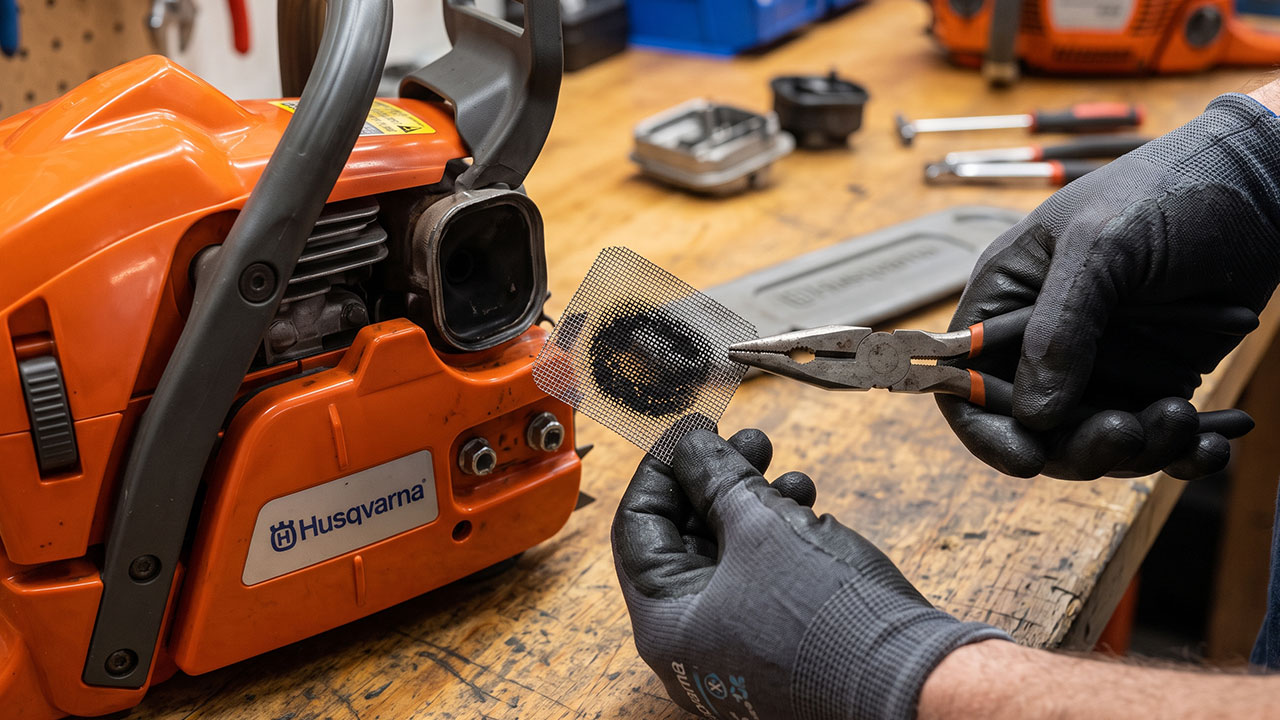
The spark arrestor is a tiny metal screen inside your muffler. Its job is to stop hot sparks from flying out and starting a forest fire. But over time, carbon exhaust builds up on this screen.
When the screen gets clogged, the engine cannot exhale. If the engine cannot push exhaust out, it cannot pull fresh air and fuel in. It will idle fine, but it will choke when you hit the gas.
I check this first because it takes two minutes. Remove the muffler cover. Pull out the little mesh screen. If it looks black and blocked up, grab a propane torch. Hold the screen with pliers and burn the carbon off until the wire mesh is clean.
| Tool Needed | Purpose |
| Pliers | To safely hold the hot screen |
| Propane Torch | To burn off solid carbon buildup |
| Wire Brush | To gently scrub away loose ash |
Filthy Air Filters Choking the Engine
Chainsaws work in incredibly dirty environments. Sawdust gets everywhere. The air filter on a Husqvarna sits right on top, under the plastic cover.
If that filter is caked in fine dust, the engine cannot breathe. When you squeeze the throttle, the engine tries to suck in a massive amount of air. If the filter is blocked, it sucks in too much fuel instead. This floods the engine, and it dies. I pop the cover off and tap the filter against my workbench. If a cloud of dust falls out, I wash it with warm soapy water and let it dry completely.
Bad Fuel and Cracked Lines
Gasoline does not last forever. If your saw sat in the shed all winter with fuel in it, that gas is now stale. Worse, modern gas has ethanol in it. Ethanol pulls moisture from the air and turns into a gooey mess that ruins small engines.
Ethanol also eats rubber. Check the fuel lines running from the gas tank to the carburetor. They should feel soft and flexible. If they feel hard, brittle, or have tiny cracks, they are sucking in air. An air leak means your engine is not getting the right fuel mix.
| Fuel Issue | The Consequence |
| Stale gas (over 30 days old) | Loses combustibility, leaves varnish |
| Cracked fuel line | Sucks in air, causes lean stalling |
| Water in fuel | Sinks to bottom, stops ignition |
Adjusting the Carburetor (The Most Common Fix)
If your spark arrestor is clean, your air filter is spotless, and you have fresh fuel, the carburetor is likely the culprit. This is the most common reason a Husqvarna chainsaw cuts out when throttle is applied.
Your carburetor controls the mix of air and gas. Over time, vibrations from cutting wood can actually cause the adjustment screws to back out slightly. Also, changes in weather, temperature, or altitude can change how your saw runs. Tuning the carb sounds scary, but it is actually very simple once you know what the screws do.
Understanding the L, H, and T Screws
Look at the side of your Husqvarna. You will see three small holes. Sometimes they have little guide ridges around them. Inside these holes are three screws labeled L, H, and T.
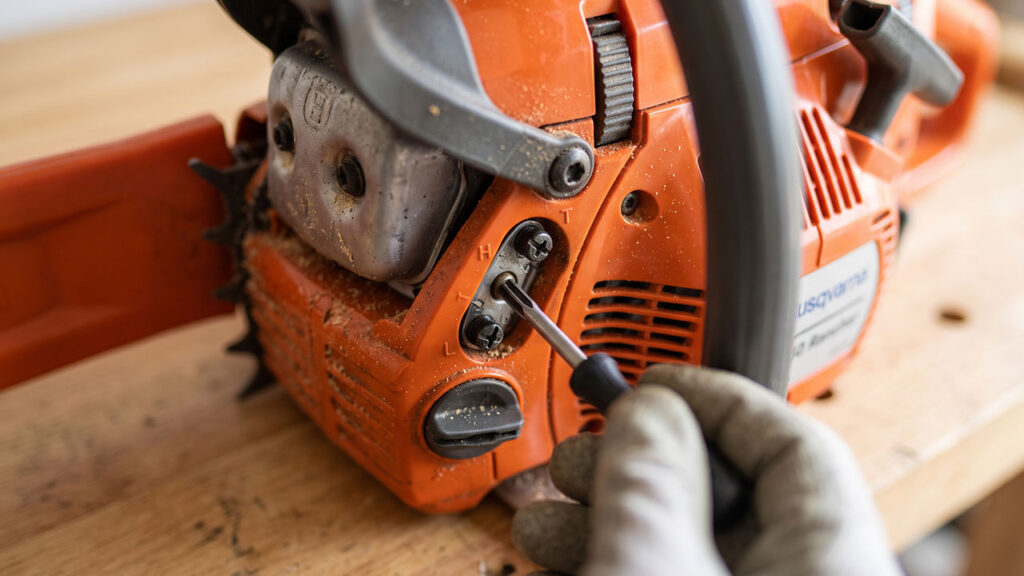
You need a special splined carburetor adjustment tool for most modern Husqvarna saws. A regular flathead screwdriver will not work.
Best 12-Inch Battery Chainsaw: Top Models for 2026
The “T” screw controls your idle speed. The “L” screw controls the low-speed fuel mixture. This affects how the saw accelerates. The “H” screw controls the high-speed fuel mixture. This affects how the saw runs at wide-open throttle.
| Screw Label | What It Controls |
| T (Idle) | How fast the engine spins without throttle |
| L (Low Speed) | Fuel mix from idle up to mid-throttle |
| H (High Speed) | Fuel mix at maximum wide-open throttle |
Finding the Sweet Spot for the Low Speed Screw
When your saw dies right as you pull the trigger, the problem is almost always the “L” screw. The engine is running too lean on the low end. It needs more fuel to bridge the gap between idling and full speed.
Here is exactly how I tune it. I start the saw and let it warm up for a few minutes. Then, I let it idle. I take my splined carb tool and put it on the “L” screw. I turn it counter-clockwise (to the left) just a tiny bit. I am talking about a 1/8 to 1/4 of a turn. This makes the mixture richer.
Then, I snap the throttle. If it revs up smoothly without hesitation, I am done. If it still bogs down, I turn it counter-clockwise another tiny hair. You just have to find that sweet spot where the acceleration feels crisp and instant.
Deeper Issues If It Still Bogs Down
Sometimes, a quick tune-up does not fix the problem. If you have adjusted the “L” screw and the saw still dies under load, you have to dig a little deeper into the fuel system. Do not panic. You can still fix this at home.
Checking the Fuel Filter
Inside your gas tank, attached to the end of the fuel line, sits a small fuel filter. It looks like a little white sponge or cylinder. Its job is to catch dirt before it reaches the carburetor.
If that filter gets clogged with debris or wood chips, fuel cannot flow fast enough. At idle, enough gas drips through to keep the engine running. But on full throttle, the engine sucks the line dry, and the saw cuts out.
I take a piece of stiff wire, bend a hook on the end, and fish the fuel filter out of the gas tank. If it looks dark, dirty, or hard, I pull it off the line and push a new one on. They cost a few dollars and save massive headaches.
| Filter Condition | Action Required |
| Bright white and porous | Leave it alone, it is working fine |
| Discolored, stiff, or gummy | Replace immediately |
A Gunked-Up Carburetor Rebuild
If you left gas in your saw for months, the carburetor itself might be clogged inside. Small engine carburetors have tiny ports and passages that are smaller than a needle.
They also rely on flexible rubber diaphragms to pump the fuel. If ethanol gas sits on those diaphragms, they turn stiff like cardboard. A stiff diaphragm cannot pump fuel. When you hit the gas, the engine starves.
Rebuilding a carburetor sounds intense, but it is just removing a few screws, spraying carb cleaner through the tiny holes, and putting new rubber gaskets in. You can buy a rebuild kit for your specific Husqvarna model for very cheap. I usually lay out a clean white towel on my bench so I do not lose the tiny springs.
Mistakes I Made While Troubleshooting
I have made plenty of errors trying to get my saws running right. My biggest mistake was ignoring the fuel mixture rules. I used to buy cheap gas and guess the oil ratio. That ruined my fuel lines fast.
Another mistake I made was messing with the “H” screw too much. The high-speed screw is dangerous if you do not know what you are doing. If you turn it too lean, the saw will sound amazing and spin incredibly fast. But it is running so hot that it will score the piston and destroy the engine in minutes. I never touch the “H” screw unless I have a digital tachometer to check the RPMs.
I also used to leave fuel in the saw during the off-season. I thought adding fuel stabilizer was enough. It is not. Stabilizer helps, but nothing beats an empty, dry tank.
| The Mistake | The Better Approach |
| Guessing the gas/oil mix | Use a dedicated measuring cup |
| Tuning the H screw by ear | Only tune H screw with a tachometer |
| Leaving gas in over winter | Run the tank completely dry |
Preventive Habits I Actually Stick To
I hate fixing tools when I am supposed to be working. So, I forced myself to adopt a few habits that keep my Husqvarna running flawlessly.
First, I only use ethanol-free fuel. It costs a little more at the pump, but it completely eliminates carburetor gunk and rotting fuel lines. If you cannot find ethanol-free gas locally, buy the pre-mixed canned fuel at the hardware store. It is expensive, but it stays fresh for years.
Second, I empty the tank when I am done cutting for the season. I dump the gas back into my gas can. Then, I start the saw and let it run until it dies. That pulls every last drop of fuel out of the carburetor lines.
Finally, I keep my air filter clean. I blow it off with an air compressor after every major cutting job. A clean saw runs cooler, uses less fuel, and responds to the throttle instantly.
| Maintenance Task | How Often I Do It |
| Tap out the air filter | After every day of cutting |
| Check the spark arrestor | Once every season |
| Empty out the fuel tank | Before winter storage |
Final Thoughts
It is annoying when your Husqvarna chainsaw cuts out when throttle is applied, but it is rarely a fatal engine problem. It is almost always a simple starvation issue. The engine is simply begging for more fuel or more air. By checking the spark arrestor, cleaning the air filter, and giving that “L” screw a tiny twist, you will fix the issue 90 percent of the time.
Do not let a bogging chainsaw ruin your weekend. Take your time, work methodically, and eliminate the easy stuff first. Treat your saw to good, clean, ethanol-free fuel, and it will reward you with years of reliable cutting. Keep your chain sharp, stay safe out there, and enjoy the work.