Starting Stihl MS170: My Honest Guide to Getting It Running Every Time
I remember the exact day I bought my Stihl MS170. It was my first real gas chainsaw. I needed it to clear some fallen branches after a heavy summer storm. I brought it home, filled it up with fresh fuel, and spent twenty minutes yanking the pull cord. Nothing happened. My shoulder ached, I was sweating, and I was completely convinced the brand-new saw was broken.
It turns out, the saw was fine. The problem was me. I quickly learned that starting Stihl MS170 chainsaws is incredibly easy, but only if you follow the exact right sequence. Gas chainsaws are not like electric tools. You cannot just flip a switch and pull a trigger. There is a specific rhythm to it. Once you learn the steps, this little saw will fire up on the second or third pull every single time. Here is exactly how I learned to do it, mistakes and all.
The Secret is the Master Control Lever
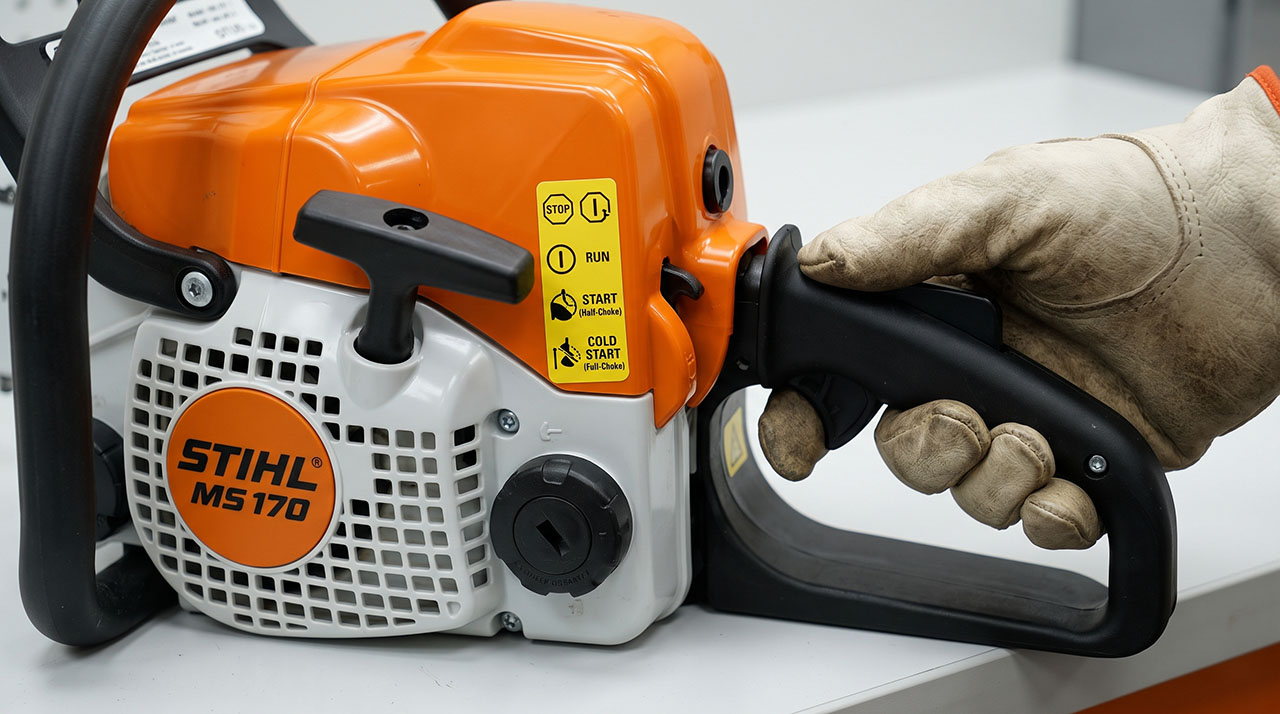
Before you even pull the cord, you have to understand the main switch on the left side of the handle. Stihl calls this the Master Control Lever. It controls the choke, the throttle advance, and the kill switch all in one spot.
When I first tried starting my Stihl MS170, I fought with this switch. I tried pushing it all the way down to the cold start position, but it felt stuck. I forced it and almost broke the plastic. I did not realize there was a safety trick. You have to squeeze the throttle trigger with your right hand before you can push the lever all the way down with your thumb.
Lever Positions Explained
If you do not know what the lever positions mean, you will flood the engine. It is that simple. The lever has four stops. You need to know them by heart.
| Lever Position | What It Actually Means |
| Top (0) | Engine off. This kills the spark. |
| Middle (I) | Normal run position. Use this when cutting. |
| Half-Choke | Warm start position. Gives a little extra gas. |
| Bottom | Full choke (Cold start). Closes air off completely. |
The Cold Start Method for the Stihl MS170
A cold start happens when the saw has not been running for a few hours. The engine block is physically cold to the touch. This is where most people mess up. They pull and pull, hoping it will just start. But there is a very specific sequence you must follow.
Setting Up the Saw Safely
First, put the saw on flat ground. Make sure the chain is not touching anything. Push the front hand guard forward to engage the chain brake. This is a crucial safety step. If the saw starts and the brake is off, the chain will spin immediately.
Next, squeeze the throttle trigger and push the Master Control Lever all the way down to the bottom. This is the full choke position. It feeds extra fuel to the cold engine. Now, put your right foot inside the rear handle to hold the saw down flat. Grab the front handlebar with your left hand.
Listening for the Magic “Burp”
This is the single most important lesson I learned about starting Stihl MS170 saws. When the lever is on full choke, you are going to pull the starter cord. You are not trying to actually start the saw here. You are just trying to make it “pop” or “burp.”
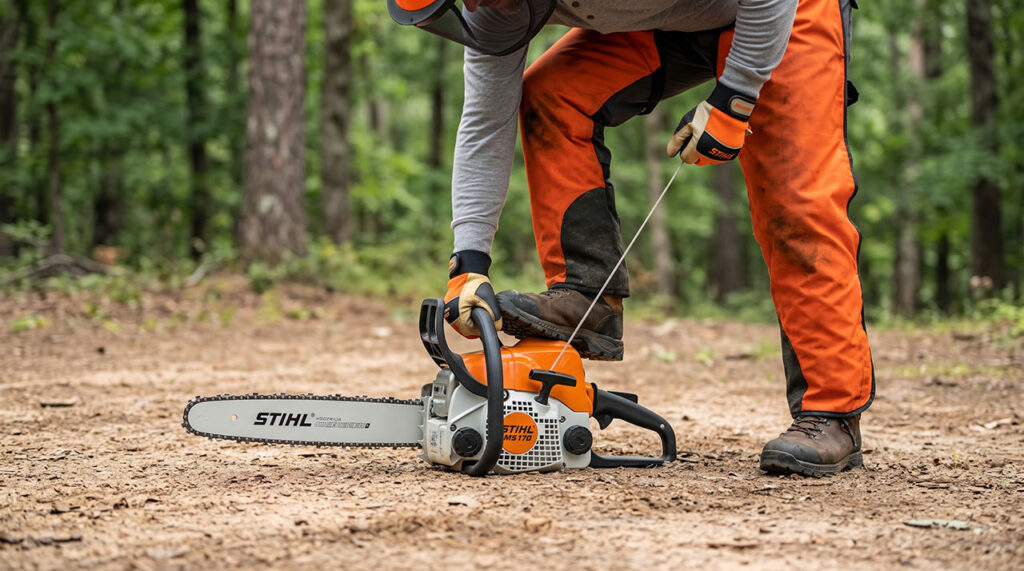
It sounds like a quick sputter or a false start. The engine tries to turn over for half a second, then dies. As soon as you hear that burp, stop pulling. If you miss that sound and keep pulling on full choke, you will flood the engine with too much gas. Usually, this pop happens on the second or third pull.
Finishing the Cold Start
Once you hear the pop, move the Master Control Lever up one notch to the half-choke position. Do not squeeze the throttle yet, or the lever will snap all the way up to the normal run position. Just click it up one spot with your thumb.
Now, pull the starter cord again. On the first or second pull, the saw should roar to life. Because it is on half-choke, the engine will be revving very high. To idle it down, just quickly tap the throttle trigger with your finger. The Master Control Lever will automatically snap up to the normal run position, and the saw will settle into a nice, calm idle.
| Cold Start Step | What to Do |
| 1. Full Choke | Squeeze trigger, push lever all the way down. |
| 2. Listen for Pop | Pull cord until the engine briefly sputters. |
| 3. Half Choke | Move lever up one notch. Pull until it starts. |
How to Do a Warm Start
Starting Stihl MS170 chainsaws when the engine is already warm is a completely different process. Let’s say you just cut down a tree. You turn the saw off to move some branches. Ten minutes later, you need to cut again. The engine is still hot.
If you try the cold start method now, you will ruin your afternoon. You will flood the engine instantly. I did this constantly during my first month owning the saw.
The Simple Warm Start Process
For a warm start, leave the Master Control Lever exactly where it is. It should already be in the normal run position (the “I” setting).
Put the saw on the ground. Engage the chain brake. Pull the cord. Usually, a warm Stihl MS170 will start on the very first pull. You do not need the choke at all. If the saw has been sitting for maybe thirty minutes and is starting to cool down, but isn’t totally cold, you might need the half-choke setting. But never use full choke on a warm saw.
| Scenario | Choke Setting to Use |
| Cold engine (sat overnight) | Full choke, listen for pop, then half choke. |
| Warm engine (just ran) | Normal run position. No choke needed. |
| Lukewarm engine (sat 30 mins) | Half-choke position. |
Help! My Stihl MS170 Won’t Start (Flooded Engine)
We have all been there. You were not paying attention, you missed the “burp” sound, and you pulled the cord five times on full choke. Now you smell raw gasoline. Your engine is flooded. This means there is too much liquid fuel in the cylinder, and the spark plug cannot ignite it.
When my saw flooded for the first time, I panicked. I thought I broke the carburetor. But fixing a flooded MS170 is actually a very simple mechanical process. You just need to clear the excess fuel out.
The Standard Un-Flooding Trick
First, take a deep breath. Move the Master Control Lever to the normal run position (the “I”). Do not use the choke at all.
Now, you need to hold the throttle trigger completely wide open. Put your foot in the back handle, hold the front handle, and use your left hand to hold the trigger down while you pull the cord. It is awkward. You might need a friend to hold the throttle for you. Pull the cord five to ten times. It will sound dead, then it will slowly start to sputter, clear the extra gas, and eventually fire up in a big cloud of smoke.
The Advanced Un-Flooding Method
If the trick above does not work, the engine is badly flooded. You need to physically remove the extra fuel.
Take your scrench tool (the wrench that came with the saw) and take off the top orange cover. Unscrew the spark plug. It will likely be soaking wet with gas. Wipe it dry with a clean rag.
While the spark plug is still out, turn the chainsaw completely upside down. Pull the starter cord three or four times. You will actually see a mist of raw gasoline spray out of the spark plug hole. Turn the saw right side up, put the dry spark plug back in, put the wire back on, and try a warm start. It will fire right up.
| Flooding Fix | When to Use It |
| Hold Throttle Open | Mild flooding. Missed the burp by 1 or 2 pulls. |
| Remove Spark Plug | Severe flooding. Saw smells heavily of raw gas. |
Common Mistakes When Starting Stihl MS170 Chainsaws
Over the years, I have watched friends and neighbors struggle with their Stihl saws. Almost every time, they are making one of three very basic mistakes.
The MS170 is an entry-level saw. It is built tough, but it is also sensitive to user error. If you treat it right, it lasts forever. If you get lazy with your habits, it will fight you every step of the way.
Pulling the Cord Incorrectly
A lot of beginners treat the starter cord like a lawnmower. They grab the handle and yank it as hard and fast as they can from a dead stop. This is a great way to break the starter mechanism.
Instead, you need to pull the cord slowly for about two inches until you feel resistance. That resistance means the starter pawls have engaged with the flywheel. Once you feel that tension, give it a firm, crisp pull. You do not need to pull it all the way out to the end of the rope. A short, fast pull is much better than a long, violent yank.
Leaving Old Gas in the Tank
Gasoline goes bad very quickly. If you mix your 2-cycle oil and gas, and leave it sitting in a gas can for four months, it will turn into a sticky, useless mess.
If you leave that old gas in your MS170 over the winter, the ethanol in the gas will attract water. It will gum up the tiny jets inside the carburetor. When spring comes, you can pull the cord until your arm falls off, but the saw will never start. Always use fresh, premium gas. If you are storing the saw for the winter, empty the gas tank completely and run the saw until it dies.
| Common Mistake | Better Approach |
| Yanking cord loosely | Pull slowly until tension, then pull firmly. |
| Using old, stale fuel | Mix small batches. Use fresh gas only. |
| Guessing the choke | Always follow the cold/warm start rules exactly. |
Quick Maintenance Tips for Reliable Starts
Starting Stihl MS170 chainsaws should not be a workout. If you are doing the sequence right, and the saw still refuses to start, you usually have a basic maintenance issue.
This saw needs three things to run: fuel, air, and spark. If any of those are blocked or failing, the saw simply will not turn over. Luckily, checking these things takes about five minutes.
Checking the Spark Plug
The spark plug is the heart of the engine. Over time, the tip of the plug gets covered in black carbon buildup from the oil in the fuel mix.
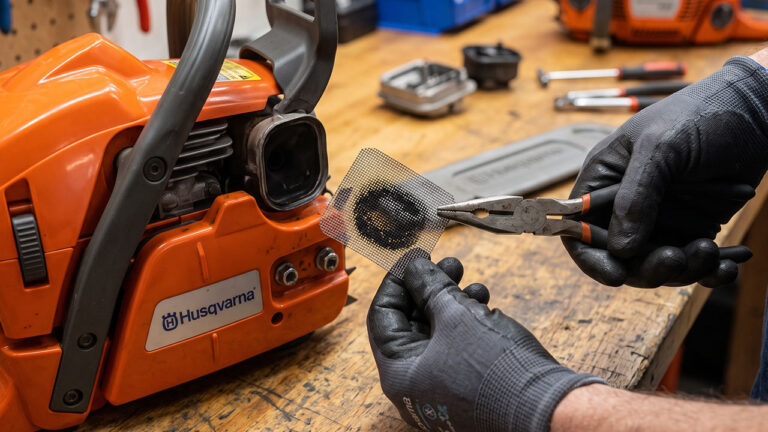
I make it a habit to change my spark plug once a year. It costs less than five dollars. If your saw is hard to start, take the plug out and look at it. If it is pitch black, crusty, or the metal gap looks worn down, throw it away and put a new one in. It makes a massive difference in how easily the saw starts.
Keeping the Air Filter Clean
Chainsaws create a lot of sawdust. That dust gets sucked right toward the carburetor. The MS170 has a small felt air filter sitting on top of the engine to block that dust.
If that filter gets clogged with wood chips and dirt, the engine cannot breathe. It acts like it is constantly on full choke. Every time I use my saw, I pop the top cover off and brush the air filter clean. Do not wash it with water. Just lightly tap the dust out of it or brush it with a soft paintbrush.
| Maintenance Task | How Often I Do It |
| Clean the air filter | After every single day of cutting. |
| Replace spark plug | Once a year (usually in the spring). |
| Check fuel filter | Once a year. Replace if it looks dirty. |
Fuel and Oil Mixtures: The Silent Killer of Chainsaws
I have to talk about fuel because it causes 90% of the starting problems I see. The Stihl MS170 has a 2-stroke engine. It does not have an oil pan like a car. You have to mix the engine oil directly into the gasoline.
If you just pour straight gasoline into this chainsaw, it will start, run for about three minutes, and then the engine will permanently weld itself together from friction. The saw will be completely destroyed.
Getting the 50:1 Ratio Right
Stihl requires a 50:1 fuel mixture. That means 50 parts gasoline to 1 part 2-cycle engine oil.
I highly recommend buying Stihl’s little bottles of synthetic 2-cycle oil. One small bottle mixes perfectly with exactly one gallon of gas. It takes all the math and guesswork out of it. Also, try to use ethanol-free gas if you can find it. Ethanol eats away at the plastic fuel lines inside the chainsaw over time.
| Fuel Issue | What Happens to the Saw |
| Straight gas (No oil) | Engine overheats and destroys itself instantly. |
| Too much oil (Rich) | Saw smokes heavily and spark plug fouls quickly. |
| Old, stale gas | Carburetor gets clogged. Saw won’t start. |
Last Thoughts
Learning the proper steps for starting Stihl MS170 chainsaws saved me a lot of frustration. It went from being a tool I dreaded using, to my favorite piece of yard equipment. The biggest lesson I learned was simply paying attention to the saw. Listening for that tiny “burp” on full choke changed everything for me. It is a reliable, hardworking machine once you understand its language.
If you are struggling right now, do not get mad at the saw. Take a break, clear the flooded engine, put fresh gas in it, and try the steps again slowly. Respect the Master Control Lever, keep your spark plug clean, and your MS170 will give you years of easy firewood cutting.