Safety Helmet for Chainsaw: My Real-World Guide to Head Protection
The first time I fired up a chainsaw, I thought I was fully prepared. I put on a pair of cheap plastic safety glasses and shoved some foam plugs into my ears. I figured that was all the protection I needed to cut up a fallen oak tree in my backyard.
I was completely wrong. Within ten minutes, my face was covered in sawdust. My safety glasses fogged up so badly I could barely see the wood. My ears were ringing despite the foam plugs. And worst of all, a thick dead branch snapped off the trunk and missed my head by inches. That was the day I realized a proper safety helmet for chainsaw work is not optional. It is an absolute necessity if you want to walk away from a weekend of cutting in one piece.
Here is what I have learned from years of running a saw, making mistakes, and figuring out what actually keeps you safe in the woods.
Why a Standard Hard Hat Isn’t a Safety Helmet for Chainsaw Work
A lot of beginners grab a standard construction hard hat and think they are good to go. I made this exact same assumption early on. But a chainsaw environment is vastly different from a standard construction site.
A basic hard hat is only designed to stop things from falling straight down on your head. When you are running a saw, danger comes from every single direction. Wood chips fly into your eyes. The engine screams in your ears. Saplings whip back at your face. You need a complete system, which is why a dedicated safety helmet for chainsaw use combines head, face, and hearing protection into one unit.
The Danger of Falling Branches (Widowmakers)
When you cut into a tree, the vibration travels all the way up the trunk. This heavy shaking easily knocks loose dead branches hanging high up in the canopy.
Loggers call these dead branches “widowmakers” for a very dark reason. They fall completely silently. You will not hear them coming over the roar of your engine. A solid safety helmet absorbs the blunt force of a falling branch, distributing the impact across the inner suspension system so your skull does not take the hit.
Kickback and Face Protection
Kickback happens when the upper tip of the chainsaw bar touches something hard. The chain catches the wood and violently throws the entire saw upward and backward.
It happens faster than you can blink. If your chain brake fails to stop the chain instantly, or if the saw body hits your face, a standard hard hat will do absolutely nothing. A forestry helmet features a sturdy visor that drops down over your face. It will not stop a spinning chain at full throttle, but it greatly reduces the severity of blunt force impacts and flying debris during a sudden kickback.
| Gear Type | Main Protection | Chainsaw Readiness |
| Standard Hard Hat | Top impact only | Very Poor |
| Safety Glasses | Eye protection | Poor (Will fog up) |
| Chainsaw Helmet | Top impact, face, hearing | Excellent |
Breaking Down the 3-in-1 Design
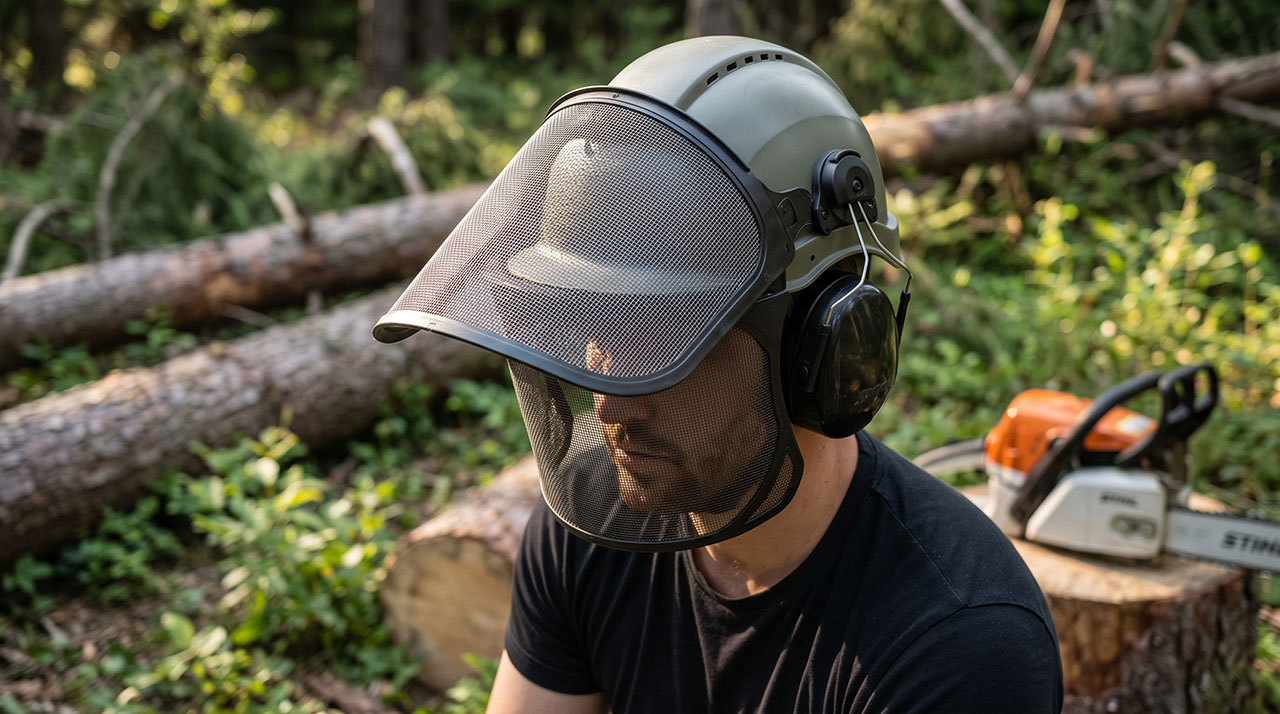
When you buy a safety helmet for chainsaw work, you are actually buying three distinct pieces of safety gear built into a single frame.
Understanding how these three parts work together changed how I view my safety gear. I used to think the helmet was just a nuisance I had to wear. Now, I see it as a perfectly designed tool that lets me focus entirely on my cutting.
Best 12-Inch Battery Chainsaw: Top Models for 2026
The Shell (Impact Protection)
The hard outer shell is usually made of thick ABS plastic. It is tough, slightly flexible, and designed to crack under extreme pressure rather than shatter into sharp pieces.
Inside the shell is a suspension system. This is a web of straps that sits on your head. The shell itself should never actually touch your skull. If a branch hits the helmet, the suspension stretches to absorb the shock, stopping the force from transferring to your neck and spine.
The Visor (Mesh vs. Clear)
My first helmet had a clear plastic face shield. I thought it would offer the best protection. I was wrong.
Within five minutes of working up a sweat, the clear plastic fogged up completely. I kept lifting it to see what I was doing, which completely defeated the purpose of wearing it. I quickly switched to a steel mesh visor. A mesh visor stops flying wood chips, sawdust, and whipping branches, but it allows air to flow freely. You never have to worry about it fogging up on a humid summer day.
The Earmuffs (Hearing Preservation)
A gas chainsaw easily hits 110 decibels or more. Hearing damage is not just about going deaf over time. It is about a permanent, high-pitched ringing in your ears that never goes away.
The earmuffs attached to a chainsaw helmet snap down tightly over your ears. They block out the damaging high frequencies of the engine while still allowing you to hear the low-pitched crack of a tree starting to fall.
| Helmet Part | Main Purpose | My Top Recommendation |
| Outer Shell | Stops blunt force impacts | Look for a 6-point suspension |
| Face Visor | Blocks chips and branches | Always choose steel mesh |
| Earmuffs | Prevents permanent hearing loss | Ensure they snap tightly |
Mistakes I Made When Buying My First Chainsaw Helmet
I hate spending money when I do not have to. When I bought my first helmet, I sorted the options by the lowest price and bought the cheapest one I could find.
That was a frustrating waste of money. The helmet sat terribly on my head, the earmuffs did not seal against my skin, and the plastic felt cheap. I ended up throwing it away and buying a quality helmet a month later. Here are the things I misunderstood the first time around.
Ignoring the Noise Reduction Rating (NRR)
Not all earmuffs are created equal. Every set of earmuffs has an NRR, which stands for Noise Reduction Rating.
I completely ignored this number on my first helmet. The muffs were so thin that my ears still rang after a short cutting session. If you are running a gas chainsaw, you want an NRR of at least 24. Anything lower than that, and you are slowly damaging your hearing every time you pull the starter cord.
Fumbling with the Adjustment Dial
Helmets come with two main ways to adjust the fit. One is a pin-lock system, where you push plastic pins into holes like on a cheap baseball cap. The other is a ratchet dial, which is a small knob on the back of the helmet.
My cheap helmet used a pin-lock system. If I wanted to tighten it, I had to take the helmet off, pop the pins out, guess the right size, and put it back on. It was miserable. Always buy a helmet with a ratchet dial. You can reach behind your head and twist the dial to tighten the helmet with one hand, even while wearing thick leather gloves.
| Adjustment Type | Ease of Use | Glove Friendly? |
| Pin-Lock | Annoying and slow | No |
| Ratchet Dial | Fast and secure | Yes |
Comfort vs. Safety: What It Actually Feels Like to Wear One
Let us be completely honest. Wearing a safety helmet for chainsaw work is not a luxurious experience.
It adds weight to your head, it traps heat, and it can feel slightly claustrophobic the first time you pull the visor down. But you get used to it very quickly. Once you experience a wood chip bouncing off the steel mesh instead of hitting your eyeball, you will never complain about the helmet again.
Dealing with the Summer Heat
Cutting firewood in the middle of summer is exhausting. When you wear a full helmet, your head is going to sweat profusely.
The sweatband inside the front of the helmet will soak through quickly. One of the best tricks I learned is to buy a helmet with a removable, washable sweatband. I bought three extra replacement bands. When one gets totally soaked, I pull it out, stick a dry one in, and toss the wet one in the washing machine later. It makes a massive difference in comfort.
The Neck Fatigue Factor
A quality forestry helmet weighs a couple of pounds. That does not sound like much, but after four hours of looking down at logs, your neck muscles will feel it.
You can minimize neck fatigue by ensuring the helmet is perfectly balanced. If the helmet is too loose, it will tilt forward when you look down, forcing your neck to hold the extra leverage. Keep the ratchet dial tight so the helmet stays perfectly centered on your crown.
| Discomfort Issue | The Reality | My Practical Solution |
| Sweaty Forehead | Unavoidable in summer | Use replaceable sweatbands |
| Foggy Vision | Happens with clear shields | Switch to a mesh visor |
| Sore Neck | Happens on long work days | Keep the dial tightened securely |
Getting the Fit Right (Why Most People Wear It Wrong)
You would be amazed at how many people I see wearing their safety gear completely wrong.
A helmet only works if it stays on your head during an impact. If it falls off when a branch hits you, or if it slips over your eyes while you are running a saw, it becomes a dangerous liability.
The Importance of the Chin Strap
Many basic helmets do not come with a chin strap. If you are just cutting firewood on flat ground, you might get away without one.
But if you are climbing over logs, working on a steep hill, or dealing with heavy brush, a chin strap is vital. If a branch whacks the side of your helmet, a chin strap keeps the helmet from flying off into the dirt. I always look for a helmet that includes a strong, adjustable chin strap.
Adjusting the Earmuff Tension
The earmuffs on a chainsaw helmet serve two purposes. They block noise, but they also act as clamps that hold the helmet steady on your head.
When you pull the earmuffs down over your ears, they should click into place and press firmly against your skin. If you are wearing thick safety glasses with thick frames, the frames will break the seal of the earmuffs, letting engine noise leak in. Look for safety glasses with very thin, flat arms so the earmuffs can still seal tightly against your head.
Real Scenarios Where My Helmet Saved the Day
It is easy to skip the helmet when you are just making “one quick cut.” I used to think that way too.
But accidents never happen when you expect them. They happen when you are tired, rushing, or doing something seemingly simple. Over the years, my helmet has saved me from serious injury more times than I can count.
The Whipping Sapling
A few years ago, I was clearing some dense brush along my fence line. I pushed into a thicket to cut a small maple sapling that was bent over under the weight of a larger fallen tree.
I did not realize how much tension the sapling was under. As soon as my chain bit into the wood, the sapling snapped upwards violently. A thick branch whipped straight back and slammed into my face. It hit my mesh visor so hard it actually dented the steel screen. If I had not been wearing my safety helmet for chainsaw use, that branch would have shattered my nose or taken out an eye. I had to buy a replacement visor, but my face did not have a single scratch.
The Unexpected Wood Chip Shower
When you use a chainsaw to bore directly into the center of a log, the chain throws wood chips differently than a normal downward cut.
Instead of throwing sawdust down at your boots, boring often shoots a straight stream of sharp wood chips directly at your chest and face. The first time I tried this technique, a massive spray of wet pine chips blasted my face shield. My earmuffs blocked the roaring engine noise, and the mesh visor stopped the chips. I just closed my eyes behind the mesh and finished the cut safely.
| Danger Scenario | What Happened | How the Helmet Saved Me |
| Spring Pole Snap | Sapling whipped my face | Visor absorbed the blunt force |
| Boring Cut | Chips shot at my eyes | Mesh screen blocked all debris |
| Low Hanging Branch | Walked backwards into a limb | Hard shell stopped a skull bump |
How to Maintain Your Chainsaw Safety Gear
A safety helmet is not a “buy it for life” item. It is a piece of safety equipment that naturally wears out over time.
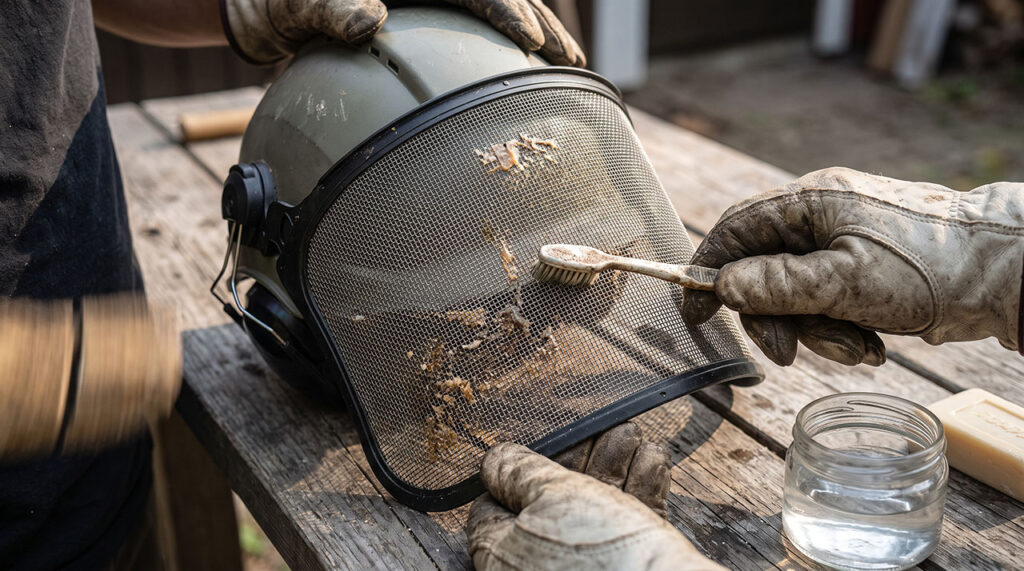
Dirt, sweat, bar oil, and the sun all take a heavy toll on the plastics and fabrics. If you do not maintain your helmet, it will eventually fail you when you need it most. I spend ten minutes cleaning my gear after every long weekend of cutting.
Cleaning the Mesh Screen
Wood chips are not just dry pieces of wood. They are often coated in sticky tree sap and wet bar and chain oil.
When this mixture hits your mesh visor, it sticks in the tiny holes of the screen. Over time, your vision gets darker and blurrier. I take my visor off once a month, take it into the kitchen, and scrub it gently with warm water, dish soap, and an old toothbrush. It cuts right through the pine pitch and restores my vision instantly.
Knowing When to Replace the Helmet
This is a rule most casual chainsaw users do not know: plastic hard hats expire.
UV rays from the sun slowly break down the ABS plastic shell. Over time, the plastic becomes brittle. If a branch hits a brittle helmet, the shell will shatter like glass instead of flexing. Look under the brim of your helmet. You will see a small circle stamped into the plastic showing the month and year it was manufactured. The general rule is to throw the helmet in the trash and buy a new one every three to five years, depending on how often you leave it out in the sun.
| Sign of Wear | What It Means | Required Action |
| Brittle or faded shell | UV damage weakened the plastic | Replace entire helmet immediately |
| Torn earmuff pads | Sound seal is broken | Buy replacement ear pads |
| Dented mesh visor | Vision is impaired | Buy a replacement visor screen |
Final Thoughts
Using a chainsaw is incredibly rewarding work, but it demands serious respect. These tools do not forgive mistakes, and the environment you work in is inherently unpredictable. Investing in a high-quality safety helmet for chainsaw work is the easiest and smartest decision you can make for your own wellbeing.
Do not let the initial discomfort or the extra heat deter you. Once you find a helmet with a good ratchet dial, comfortable earmuffs, and a clear mesh visor, it will quickly become second nature to wear it. Your head, your eyes, and your hearing are completely irreplaceable. Spend the money on good gear, maintain it well, and go tackle that firewood pile with absolute confidence.