Milwaukee Fuel Circular Saw 7 1/4 Problems: My Honest Fixes
I bought the Milwaukee M18 FUEL 7-1/4″ circular saw a few years ago. I thought it would completely replace my old corded saw. For the most part, it has. It cuts fast, has amazing power, and the freedom of no cords is great. But I have also run into some frustrating quirks on the job site.
If you are dealing with Milwaukee fuel circular saw 7 1/4 problems, you are not alone. I have fought with sticky guards, dead batteries, and sudden motor shutoffs. Over time, I learned how to fix these issues or work around them. I want to share exactly what went wrong with mine and how you can fix yours.
The Most Common Milwaukee Fuel Circular Saw 7 1/4 Problems
Every power tool has its weak points. Even heavy-duty tools like the M18 FUEL line have flaws. When you use a saw every single day, you start to notice these little issues quickly.
The Notorious Blade Guard Sticking Issue
This is my biggest daily annoyance. The lower blade guard on this saw gets stuck. It does not happen all the time, but it happens enough to be frustrating.
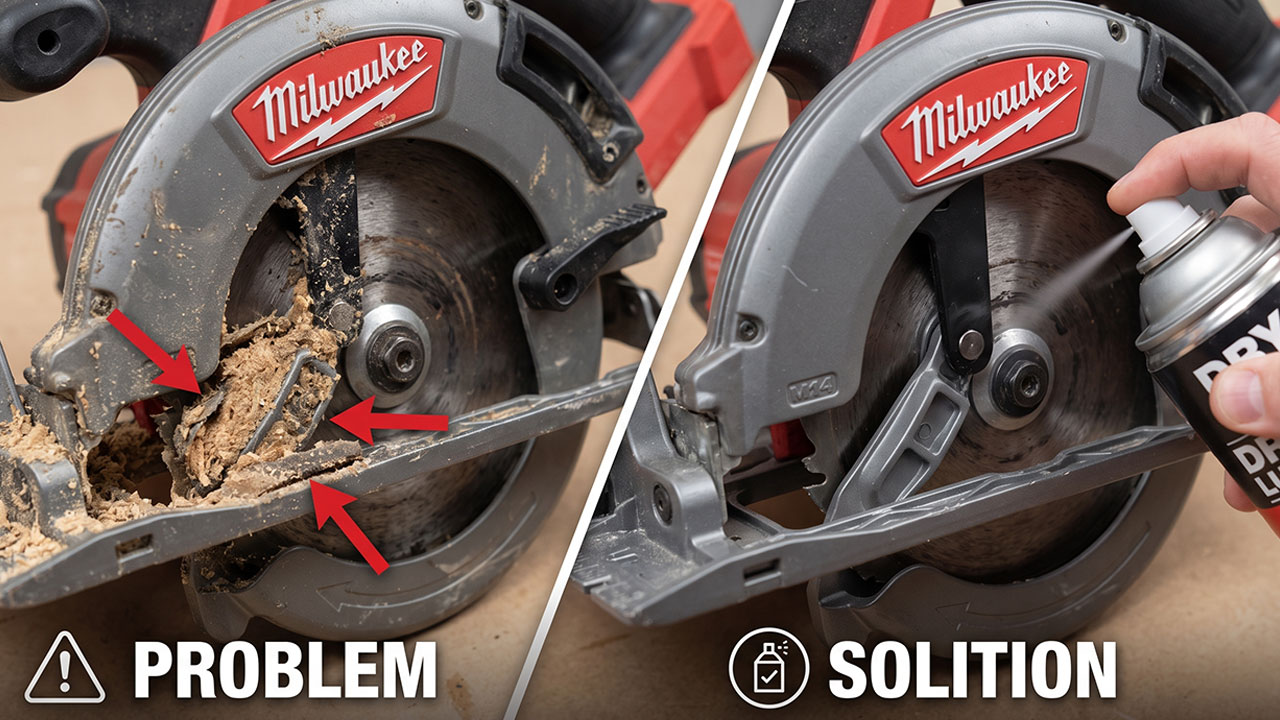
When you cut wet pressure-treated wood, damp sawdust flies everywhere. This wet dust packs tightly right into the spring mechanism of the lower guard. After a few cuts, the guard refuses to snap back into place. You finish a cut, set the saw down, and the blade is still exposed. This is incredibly dangerous.
I learned the hard way that you cannot just ignore this. It will ruin the work surface if the blade is still spinning. It can also catch your pants.
| Problem | Quick Fix |
| Guard sticking open | Blow out the spring area with an air compressor daily. |
| Guard dragging on thin cuts | Use your thumb on the guard lever before starting the cut. |
| Sticky guard spring | Apply a dry Teflon spray to the pivot point. Do not use wet oil. |
To fix this long-term, I stopped using WD-40 or wet oils on the guard. Wet oil just turns sawdust into thick mud. I now use a dry graphite or Teflon spray. It keeps the guard snapping back fast without holding onto dust.
Overheating and the Motor Shutting Down Early
The brushless motor on this saw is an absolute beast. It feels like a corded worm drive saw. But that power comes with a strict electronic brain.
Milwaukee built overload protection into this tool. If you push the saw too hard, the electronic brain shuts the motor off completely. The tool just stops mid-cut. You have to release the trigger, pull the saw back, and start over.
This happens to me mostly when ripping thick hardwoods or ripping wet 2x lumber. The saw has the raw power to push through, but the computer says no. It senses the heat or the amp draw and cuts the power to protect the internal parts.
| Symptoms | Causes |
| Sudden shutoff mid-cut | Pushing the saw too fast through dense wood. |
| Flashing battery lights | The battery pack has overheated from a heavy draw. |
| Blade stalls out completely | The wood has pinched the blade in the kerf. |
The best workaround is to let the saw do the work. Do not force it. If I am cutting two-inch oak, I slow my feed rate down. I let the blade speed stay high. If you hear the motor bogging down, you are pushing too fast.
Battery Drain and Power Loss Troubles
Cordless saws eat batteries. That is just a fact of life. But the Milwaukee M18 FUEL saw handles batteries a bit differently than other tools in the lineup.
Why the Standard 5.0Ah Battery Misses the Mark
When I first got the saw, I used my standard 5.0Ah M18 batteries. They work fine for cutting a few 2x4s. But if you plan to rip sheets of plywood all day, those batteries will frustrate you.
The standard batteries simply cannot dump power fast enough for this saw. The saw will drain a 5.0Ah battery in less than 20 minutes of heavy cutting. Worse, the saw feels weaker. It stalls out faster. It feels like it lacks torque.
| Battery Type | Performance Result |
| Standard 5.0Ah XC | Good for quick, light cuts. Drains very fast under load. |
| High Output 6.0Ah | Noticeable jump in power. Runs cooler. |
| High Output 8.0Ah / 12.0Ah | Maximum torque. Feels like a true corded saw. Heavy. |
I finally upgraded to the High Output 8.0Ah and 12.0Ah batteries. The difference was night and day. These newer batteries use bigger internal cells. They push power to the motor much faster. If you are experiencing power loss with your saw, check your battery first.
Cold Weather Battery Failures
I live in a place where winters get freezing cold. Lithium-ion batteries hate the cold.
When I leave my batteries in my truck overnight in January, the saw barely works the next morning. I will pull the trigger, and the saw just flashes its lights at me. The battery is full, but it is too cold to discharge energy.
I learned to keep my High Output batteries inside the house during winter. I bring them to the job site in a warm bag. If a battery does get too cold, I pop it into a warm charger in the truck for ten minutes to wake up the cells.
Best Circular Saw for Woodworking : Top Picks
Accuracy and Cut Line Struggles
A circular saw needs to cut straight and true. Most of the time, this saw is highly accurate out of the box. But I have chased a few alignment ghosts over the years.
Bevel Adjustment Drifting Off Square
The shoe on this saw is made of magnesium. It is light and very strong. But the bevel adjustment lock can be tricky.
I frame a lot of walls, so I need my cuts to be perfectly 90 degrees. After a few weeks of tossing the saw in my truck bed, I noticed my cuts were slightly angled. The bevel lock had slipped. It moved to about 88 degrees instead of 90.
The locking lever needs to be pushed down extremely hard. If you only press it lightly, the vibration of the motor will slowly rattle the bevel loose.
| Issue | Troubleshooting Step |
| Cuts are slightly angled | Use a speed square to reset the blade to exactly 90 degrees. |
| Bevel lever feels loose | Tighten the small nut on the back of the locking lever. |
| Saw drifts off the pencil line | Ensure you are looking down the correct notch on the front shoe. |
I now carry a small speed square in my tool belt. I check the blade angle against the shoe once a week. It takes five seconds and saves me from ruining expensive trim or framing joints.
The Blade Wobble Mystery
One day, my cuts started looking rough. The edges of the wood were splintered. The saw felt like it was vibrating heavily in my hand.
I thought the arbor was bent. A bent arbor is a death sentence for a circular saw. Thankfully, I was wrong. The problem was the blade itself.
Heat warps saw blades. I had been pushing a cheap, dull blade through wet wood. The blade got so hot that the metal actually warped. It created a severe wobble. The saw was perfectly fine. The blade was trash. I threw it out, put on a fresh Diablo thin-kerf blade, and the saw cut like butter again.
Safety and Ergonomic Quirks to Watch Out For
Cordless tools have gotten so powerful that they demand a new level of respect. This saw is no exception. It has quirks that can surprise you if you are used to older tools.
Kickback When Plunge Cutting
Plunge cuts are always a little risky. You rest the front of the shoe on the wood, pull the guard back, and slowly drop the spinning blade into the material.
Because the brushless motor on this Milwaukee is so torquey, it grips instantly. If you drop the blade in slightly crooked, the saw will violently kick back toward you. I had this happen while cutting out a window opening in some sheathing. The saw jumped right out of the wood.
| Mistake | Better Approach |
| Dropping the blade in too fast | Lower the blade very slowly, letting it chew its way in. |
| Twisting the saw during a plunge | Keep your wrist locked rigidly. Follow a straight line. |
| Plunging with a dull blade | Always use a sharp blade for plunge cuts to reduce friction. |
To avoid this, I always make sure the saw is running at full speed before the blade touches the wood. Never start the saw while the teeth are resting against the material. The instant torque will throw the saw backward every single time.
The Heavy Weight of High Output Batteries
I mentioned earlier that you need High Output batteries to get the best performance. The trade-off is the physical weight.
A Milwaukee M18 FUEL 7-1/4″ saw with a 12.0Ah battery attached is a very heavy tool. If you are cutting roof rafters all day, your shoulder will feel it. It is noticeably heavier than my old Makita corded saw.
I usually compromise. I use an 8.0Ah battery. It gives me about 85 percent of the power of the 12.0Ah, but it saves my arm from falling off by the end of the shift.
Routine Maintenance to Prevent Future Headaches
Most Milwaukee fuel circular saw 7 1/4 problems can be avoided with a little basic care. We abuse these tools, but they still need some maintenance.
Cleaning the Shoe and Depth Track
The magnesium shoe slides beautifully on dry wood. But if you cut pine or treated lumber, tree sap and glue build up on the bottom of the shoe.
Once the shoe gets sticky, the saw becomes hard to push. You end up forcing the cut, which triggers the overload sensor we talked about earlier. It becomes a frustrating cycle.
| Feature | Real-World Annoyance |
| Magnesium shoe | Collects sticky tree sap and resin easily. |
| Depth adjustment lever | Can get jammed with packed sawdust behind the track. |
| Rafter hook | Sometimes gets caught on your tool belt when you walk. |
I keep a cheap plastic putty knife in my truck. I scrape the bottom of the saw shoe clean every few days. Sometimes I wipe it down with a rag soaked in mineral spirits. A smooth shoe makes the saw feel brand new again.
When to Swap the Stock Blade
Milwaukee includes a blade in the box. It is an okay blade. It will cut two-by-fours just fine.
But if you want to eliminate most cutting problems, throw the stock blade in your backup bin. Buy a high-quality thin-kerf blade. A thin-kerf blade removes less wood. This means the motor works less. The battery lasts longer. The saw overheats less often.
I prefer a 24-tooth framing blade for general work. If I am cutting plywood, I step up to a 40-tooth or 60-tooth blade. Matching the right blade to the material solves about half of the complaints I hear from guys using this saw.
If your saw is burning the wood, smoking, or stalling, check your blade. Nine times out of ten, the blade is either dull, pitched up with sap, or the wrong type for the job. Do not blame the tool until you check the teeth on your blade.
When you address these small details, the saw becomes an absolute joy to use. The power is there. You just have to know how to manage it properly.
In the end, the M18 FUEL circular saw is easily one of the best tools I own. The sheer power and cordless freedom make my daily work so much easier. Yes, it has some quirks. The sticky guard and the battery demands can be annoying at first. But once you understand how the tool behaves, you can easily work around these issues.
If you are dealing with any of these problems right now, do not give up on the saw. Clean out that lower guard, upgrade to a High Output battery, and throw a fresh premium blade on it. Treat the tool right, and it will effortlessly slice through anything you put in front of it for years to come.
Milwaukee Fuel Circular Saw 7 1/4 Problems: My Honest Fixes
I bought the Milwaukee M18 FUEL 7-1/4″ circular saw a few years ago. I thought it would completely replace my old corded saw. For the most part, it has done exactly that. It cuts very fast. It has amazing raw power. The freedom of having no power cords dragging behind me is great. But I have also run into some frustrating quirks on the job site over the years.
If you are currently dealing with Milwaukee fuel circular saw 7 1/4 problems, you are not alone. I have fought with sticky blade guards, dead batteries, and sudden motor shutoffs. Over time, I learned how to fix these issues. Sometimes, I just had to learn how to work around them. I want to share exactly what went wrong with my saw and how you can fix yours.
The Most Common Milwaukee Fuel Circular Saw 7 1/4 Problems
Every single power tool has its weak points. Even heavy-duty tools like this one have flaws. When you use a saw every single day, you start to notice these little issues quickly.
The Notorious Blade Guard Sticking Issue
This is my biggest daily annoyance. The lower blade guard on this saw gets stuck frequently. It does not happen on every single cut. But it happens enough to make you mad.
When you cut wet pressure-treated wood, damp sawdust flies everywhere. This wet dust packs tightly right into the spring mechanism of the lower guard. After a few cuts, the guard refuses to snap back into place. You finish a cut. You set the saw down. But the blade is still fully exposed. This is incredibly dangerous.
I learned the hard way that you cannot just ignore this. It will ruin the work surface if the blade is still spinning. It can also catch your pants.
| Problem | Quick Fix |
| Guard sticking open | Blow out the spring area with an air compressor daily. |
| Guard dragging on thin cuts | Use your thumb on the guard lever before starting the cut. |
| Sticky guard spring | Apply a dry Teflon spray to the pivot point. Do not use wet oil. |
To fix this long-term, I stopped using WD-40 or wet oils on the guard. Wet oil just turns sawdust into thick mud. I now use a dry graphite or Teflon spray. It keeps the guard snapping back fast without holding onto dust.
Overheating and the Motor Shutting Down Early
The brushless motor on this saw is an absolute beast. It feels exactly like a heavy corded worm drive saw. But that power comes with a strict electronic brain.
Milwaukee built overload protection into this tool. If you push the saw too hard, the electronic brain shuts the motor off completely. The tool just stops mid-cut. You have to release the trigger. Then, you pull the saw back and start over.
This happens to me mostly when ripping thick hardwoods. It also happens when ripping wet lumber. The saw has the raw power to push through. But the computer says no. It senses the high heat or the heavy amp draw. It cuts the power to protect the internal parts from frying.
| Symptoms | Causes |
| Sudden shutoff mid-cut | Pushing the saw too fast through dense wood. |
| Flashing battery lights | The battery pack has overheated from a heavy draw. |
| Blade stalls out completely | The wood has pinched the blade in the kerf. |
The best workaround is to simply let the saw do the work. Do not force it. If I am cutting two-inch thick oak, I slow my feed rate down. I let the blade speed stay very high. If you hear the motor bogging down, you are pushing way too fast.
Battery Drain and Power Loss Troubles
Cordless saws eat batteries. That is just a basic fact of life. But this specific saw handles battery power a bit differently than other tools on the market.
Why the Standard 5.0Ah Battery Misses the Mark
When I first got the saw, I used my standard 5.0Ah M18 batteries. They work fine for cutting a few simple boards. But if you plan to rip heavy sheets of plywood all day, those batteries will frustrate you.
The standard batteries simply cannot dump power fast enough for this hungry saw. The saw will drain a 5.0Ah battery in less than twenty minutes of heavy cutting. Worse, the saw actually feels weaker. It stalls out faster. It feels like it lacks the torque you need.
| Battery Type | Performance Result |
| Standard 5.0Ah XC | Good for quick cuts. Drains very fast under heavy load. |
| High Output 6.0Ah | Noticeable jump in power. Runs much cooler. |
| High Output 8.0Ah / 12.0Ah | Maximum torque. Feels like a true corded saw. Heavy. |
I finally upgraded to the High Output 8.0Ah and 12.0Ah batteries. The difference was like night and day. These newer batteries use bigger internal cells. They push power to the motor much faster. If you are experiencing power loss with your tool, check your battery type first.
Cold Weather Battery Failures
I live in a place where winters get freezing cold. Lithium-ion batteries absolutely hate the cold.
When I leave my batteries in my truck overnight in January, the saw barely works the next morning. I will pull the trigger. The saw just flashes its lights at me. The battery is completely full. But it is too cold to discharge any energy.
I learned to keep my High Output batteries inside the house during winter. I bring them to the job site in a warm bag. If a battery does get too cold, I pop it into a warm charger in the truck for ten minutes. That wakes up the frozen cells.
Accuracy and Cut Line Struggles
A circular saw needs to cut straight and true. Most of the time, this tool is highly accurate right out of the box. But I have chased a few weird alignment ghosts over the years.
Bevel Adjustment Drifting Off Square
The shoe on this saw is made of solid magnesium. It is light and very strong. But the bevel adjustment lock can be slightly tricky to use.
I frame a lot of walls. I need my cuts to be perfectly 90 degrees. After a few weeks of tossing the saw into my truck bed, I noticed my cuts were slightly angled. The bevel lock had slipped. It moved to about 88 degrees instead of exactly 90.
The locking lever needs to be pushed down extremely hard. If you only press it lightly, the vibration of the brushless motor will slowly rattle the bevel loose.
| Issue | Troubleshooting Step |
| Cuts are slightly angled | Use a speed square to reset the blade to exactly 90 degrees. |
| Bevel lever feels loose | Tighten the small nut on the back of the locking lever. |
| Saw drifts off the pencil line | Ensure you are looking down the correct notch on the front shoe. |
I now carry a small speed square in my tool belt. I check the blade angle against the flat shoe once a week. It takes five seconds. This habit saves me from ruining expensive trim boards or sloppy framing joints.
The Blade Wobble Mystery
One day, my cuts started looking incredibly rough. The edges of the wood were heavily splintered. The saw felt like it was vibrating heavily in my hand.
I thought the metal arbor was bent. A bent arbor is a death sentence for a circular saw. Thankfully, I was totally wrong. The real problem was the blade itself.
Heat warps saw blades fast. I had been pushing a cheap, dull blade through wet wood all morning. The blade got so hot that the thin metal actually warped. It created a severe wobble. The saw was perfectly fine. The blade was trash. I threw it out. I put on a fresh Diablo thin-kerf blade. The saw cut like butter again.
Safety and Ergonomic Quirks to Watch Out For
Cordless tools have gotten so incredibly powerful. They demand a new level of respect. This saw is no exception to that rule. It has quirks that can surprise you.
Kickback When Plunge Cutting
Plunge cuts are always a little bit risky. You rest the front of the shoe on the wood. You pull the guard back. Then, you slowly drop the spinning blade down into the material.
Because the brushless motor on this Milwaukee is so torquey, it grips instantly. If you drop the blade in slightly crooked, the saw will violently kick back right toward you. I had this happen while cutting out a window opening. The saw jumped right out of the wood.
| Mistake | Better Approach |
| Dropping the blade in too fast | Lower the blade slowly. Let it chew its way in. |
| Twisting the saw during a plunge | Keep your wrist locked rigidly. Follow a straight line. |
| Plunging with a dull blade | Always use a sharp blade to reduce friction. |
To avoid this danger, I always make sure the saw is running at full speed. I wait until it screams before the blade touches the wood. Never start the saw while the teeth are resting against the material. The instant torque will throw the saw backward every single time.
The Heavy Weight of High Output Batteries
I mentioned earlier that you really need High Output batteries. You need them to get the absolute best performance. The trade-off is the physical weight of the tool.
A Milwaukee M18 FUEL saw with a massive 12.0Ah battery attached is very heavy. If you are cutting roof rafters all day long, your shoulder will feel it. It is noticeably heavier than my old Makita corded saw.
I usually compromise to save my arm. I use an 8.0Ah battery. It gives me about 85 percent of the power of the 12.0Ah. But it saves my arm from falling off by the end of my work shift.
Routine Maintenance to Prevent Future Headaches
Most Milwaukee fuel circular saw 7 1/4 problems can be avoided. You just need a little basic care. We abuse these tools on jobs. But they still need some simple maintenance.
Cleaning the Shoe and Depth Track
The magnesium shoe slides beautifully on dry wood. But if you cut pine or treated lumber, things change. Tree sap and wood glue build up on the bottom of the shoe quickly.
Once the shoe gets sticky, the saw becomes very hard to push. You end up forcing the cut. This triggers the overload sensor we talked about earlier. It becomes a highly frustrating cycle.
| Feature | Real-World Annoyance |
| Magnesium shoe | Collects sticky tree sap and resin very easily. |
| Depth adjustment lever | Gets jammed with packed sawdust behind the track. |
| Rafter hook | Sometimes gets caught on your tool belt when you walk. |
I keep a cheap plastic putty knife in my truck. I scrape the bottom of the saw shoe clean every few days. Sometimes I wipe it down with a rag soaked in mineral spirits. A perfectly smooth shoe makes the saw feel brand new again.
When to Swap the Stock Blade
Milwaukee includes a decent blade right in the box. It is an okay blade. It will cut two-by-fours just fine for a few days.
But if you want to eliminate most common cutting problems, throw that stock blade in your backup bin. Go buy a high-quality thin-kerf blade. A thin-kerf blade removes much less wood. This means the motor works less. The battery lasts longer. The saw overheats far less often.
I prefer a 24-tooth framing blade for general job site work. If I am cutting clean plywood, I step up to a 40-tooth or 60-tooth blade. Matching the right blade to the exact material solves about half of the major complaints I hear.
If your saw is burning the wood, smoking, or constantly stalling, check your blade first. Nine times out of ten, the blade is either completely dull or covered in sticky sap. Do not blame the tool until you check the sharp teeth on your blade.
When you fix these small details, the saw becomes an absolute joy to use daily. The power is definitely there. You just have to know how to manage it properly.
In the end, the M18 FUEL circular saw is easily one of the best tools I own. The sheer power and cordless freedom make my daily work so much easier. Yes, it has some annoying quirks. The sticky guard and the heavy battery demands can be frustrating at first. But once you fully understand how the tool behaves, you can easily work around these minor issues.
If you are dealing with any of these problems right now, do not give up on the saw. Clean out that lower guard spring. Upgrade to a stronger High Output battery pack. Throw a fresh premium blade on the arbor. Treat the tool right, and it will effortlessly slice through anything you put in front of it for many years to come.