Brand New Chainsaw Won’t Start ? My honest guide
You just brought it home from the hardware store. You filled it up, pulled the cord, and nothing happened. A brand new chainsaw won’t start, and it is incredibly frustrating. I know the feeling perfectly. You start wondering if you bought a lemon or if you missed something obvious in the manual.
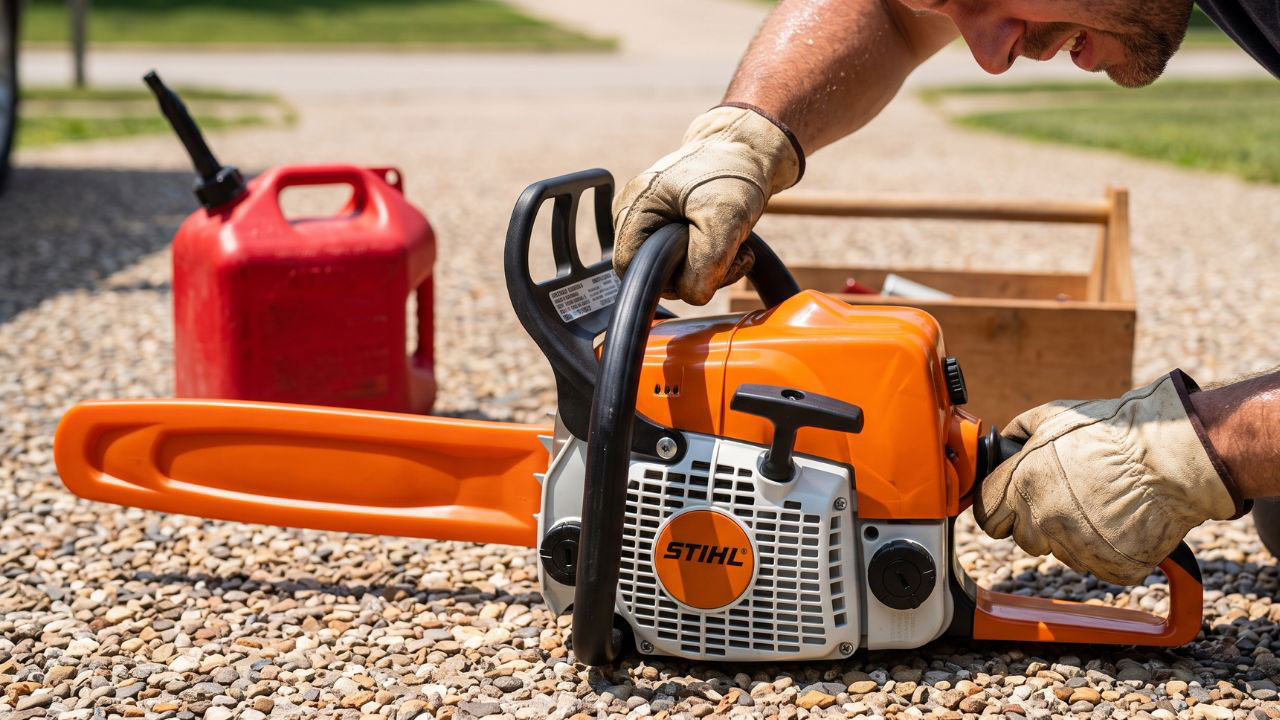
I have been there, sweating in the driveway, yanking a pull cord until my shoulder ached. The good news is that your chainsaw is probably not broken. Most of the time, this happens because of a tiny missed step in the starting routine or a simple fuel issue. Let me share exactly how I learned to troubleshoot this, so you can get your saw running today.
The “Facepalm” Checklist (Check These First)
Before we start taking things apart, we need to check the basics. I have wasted hours troubleshooting my saws, only to realize I made a silly mistake.
Is the Kill Switch Actually On?
This sounds like a joke, but it happens all the time. Every chainsaw has an ignition switch. It is usually a small toggle or a slide switch near where your thumb rests. Sometimes they are marked with an “O” for off and an “I” for on. I once pulled a cord twenty times before realizing the switch was shoved down in the “Stop” position.
If the switch is off, the spark plug gets no electricity. The engine will never fire. Double-check your switch right now. Push it up to the “Start” or “Run” position.
| Common Oversight | How to Fix It |
| Kill switch is off | Flip it to “I” or “Run” |
| Primer bulb not pressed | Press it 5 to 7 times |
| Chain brake engaged | Pull the front handle back |
The Chain Brake Might Be Engaged
New chainsaws come with a massive safety feature called the chain brake. It is the large plastic guard sitting right in front of the top handle. When this is pushed forward, the chain is locked.
Many saws will still start with the brake on. However, some newer models are highly finicky. If the brake is jammed forward, the engine might struggle to spin freely. Pull that brake handle back toward you until it clicks loudly.
Decoding the Starting Procedure
Chainsaws do not start like modern cars. You cannot just turn a key. They require a very specific sequence of air and fuel to wake up.
The Primer Bulb and Choke Dance
If your brand new chainsaw won’t start, you likely messed up the choke sequence. Cold engines need extra fuel to start. The choke flap closes off the air supply, creating a rich fuel mixture.
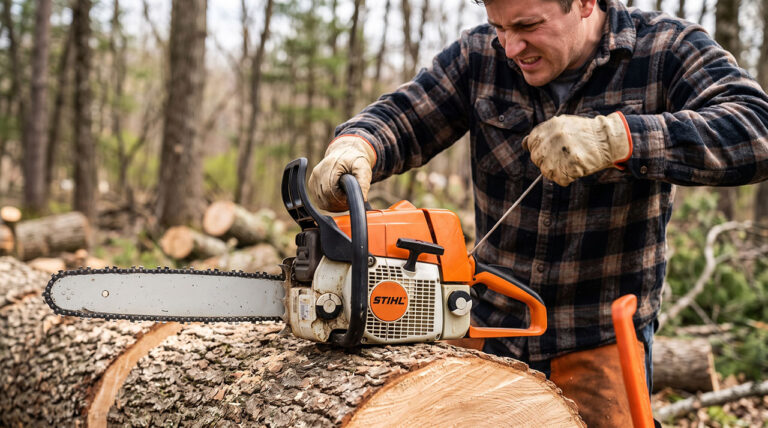
First, press the clear plastic primer bulb about six times. Stop when you see fuel inside it. Next, pull the choke lever all the way out. This sets the saw to full choke. Now, pull the starter cord quickly and firmly.
| Starting Step | What It Actually Does |
| Press primer bulb | Pulls fresh fuel into the carburetor |
| Pull choke out | Restricts air to force more fuel in |
| Push choke half-in | Gives the engine air to keep running |
Listen for the “Burp”
This is the biggest lesson I ever learned about chainsaws. When you pull the cord on full choke, you are only waiting for one thing. You are waiting for the engine to “burp” or “pop.”
It sounds like the saw is going to start for half a second, and then it dies immediately. When you hear that pop, you must push the choke in. If you ignore the pop and keep yanking the cord on full choke, you will drown the engine in gas.
How I Unflood a Stubborn Engine
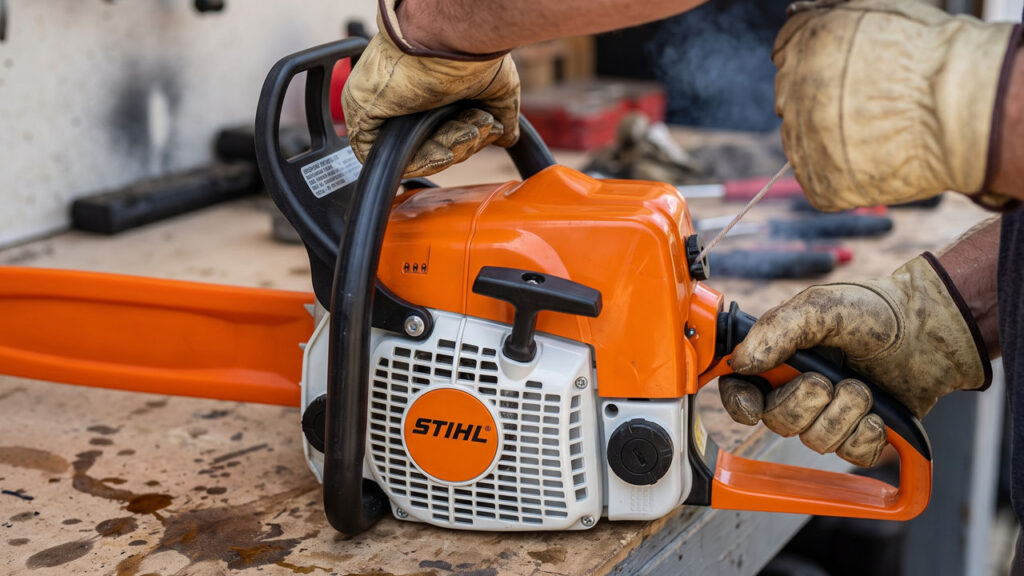
Flooding the engine is the number one reason a brand new chainsaw won’t start. If you pulled the cord ten times on full choke, your engine is flooded. It has too much liquid gas inside and not enough air to ignite it. You can usually smell strong raw gas when this happens.
The Standard Unflooding Trick
You need to clear the excess gas out of the cylinder. First, push the choke completely in. You want maximum air flowing into the engine. Next, hold the throttle trigger down all the way. You can wedge your knee against the handle to hold it if you need to.
While holding the throttle wide open, pull the starter cord over and over. It might take ten or fifteen hard pulls. Eventually, it will sputter, smoke heavily, and roar to life.
| Flooded Symptom | The Immediate Solution |
| Smells heavily of gas | Push choke in, hold throttle, pull cord |
| Cord pulls very easily | Take a break, let the gas evaporate |
| Saw sputters but dies | Keep pulling with the choke pushed in |
The Spark Plug Drying Method
Sometimes the standard trick fails. When I flood a saw really badly, I have to take it apart. Take your scrench tool and remove the top cover. Unscrew the spark plug.
You will likely see that the tip of the spark plug is dripping wet with gas. Wipe it dry with a clean rag. While the plug is out, turn the chainsaw upside down. Pull the starter cord a few times. This forces the liquid gas to spit out of the empty spark plug hole. Put it all back together, and it should start easily.
Fuel Mix Mistakes on Day One
Two-stroke engines are incredibly sensitive to bad fuel. If you just bought this saw, you probably bought a fresh gas can too. But did you mix it correctly?
Using Straight Gas by Accident
Two-stroke chainsaws do not have an oil reservoir for the engine. The oil must be mixed directly into the gasoline. If you poured plain, unmixed gasoline from the pump straight into your new chainsaw, stop immediately.
Running a chainsaw on straight gas will destroy the engine in less than two minutes. The piston will overheat and fuse to the cylinder. If you did this, dump the gas out right away and replace it with a proper 50:1 or 40:1 fuel-oil mix.
| Fuel Mistake | The Result | My Advice |
| Straight pump gas | Destroys the engine instantly | Never skip the 2-stroke oil |
| Gas older than 30 days | Clogs the carburetor | Buy fresh gas in small batches |
| Wrong mix ratio | Smokes heavily or runs poorly | Read the manual for exact ratios |
The Beauty of Pre-Mixed Fuel
When I get a new gas tool, I completely avoid the gas station. I highly recommend buying a can of engineered, pre-mixed fuel from the hardware store. Brands like MotoMix or TruFuel are a lifesaver.
This fuel has zero ethanol, stays fresh for years, and has the perfect oil ratio mixed in perfectly. If your new saw is acting stubborn, dump your homemade mix. Pour in some pre-mixed fuel instead. It solves a massive amount of starting issues.
Best Circular Saw for Woodworking
Spark and Air Issues Out of the Box
Sometimes a chainsaw leaves the factory perfectly, but things rattle loose during shipping. You might be doing everything right, but a mechanical disconnection is stopping you.
Checking the Spark Plug Wire
The spark plug wire delivers the electrical jolt needed to ignite the fuel. It has a thick rubber boot that snaps over the tip of the spark plug.
During transit, this boot can pop off. If the boot is loose, you get no spark. Pop the top plastic cover off your saw. Look for the black rubber boot. Press down firmly on it. You should feel it click or snap securely onto the metal plug.
| Part to Check | What to Look For |
| Spark plug boot | Must be snapped firmly onto the plug |
| Air filter | Must be clean and seated properly |
| Fuel lines | Look for kinks or disconnected tubes |
Inspecting the Air Filter
Your chainsaw needs to breathe. Even on a brand new unit, check the air filter. I once bought a saw where the manufacturer had left a plastic shipping film over the air intake.
Make sure the filter is seated correctly. It should lock into place tightly. If there is a gap, the engine will suck in dirt later, but right now, it might be messing with your air-to-fuel vacuum pressure.
When to Actually Return It
If you have tried unflooding it, checked the kill switch, used fresh pre-mixed fuel, and verified the spark plug wire, you might actually have a bad unit. It is rare, but manufacturing defects do happen.
Spotting Factory Defects
Sometimes a carburetor is adjusted completely wrong from the factory. If the low-speed screw is shut tight, the saw will never idle. You might also have a kinked fuel line hidden deep inside the plastic housing.
Do not start taking the carburetor apart on a brand new saw. That will void your warranty instantly. If you have spent an hour pulling the cord and trying the tricks above, it is time to put it back in the box.
| Situation | Action to Take |
| Flooded engine | Fix it yourself using the choke tricks |
| Loose spark plug wire | Snap it back on yourself |
| Carburetor won’t draw fuel | Return it to the store for exchange |
Take It Back to the Dealer
If you bought it from a big box store, simply return it. Tell them it is defective out of the box.
If you bought it from a local power equipment dealer, take it back to their service counter. The mechanics there can usually tune a tight factory carburetor in about two minutes. They will gladly show you how to start it properly before you take it home again.
Final Thoughts
Dealing with a brand new chainsaw that won’t start is a rite of passage for yard work. Almost every time it happens to me now, I realize I missed the audio cue of the engine “burping,” and I flooded it. Once you learn the rhythm of your specific saw, starting it becomes muscle memory.
Take a deep breath, step away for a few minutes if your shoulder hurts, and try the unflooding method. Stick to high-quality, pre-mixed fuel for your first few cuts. Once you hear that two-stroke engine finally scream to life, all the frustration will fade away. Stay safe out there, and happy cutting.